
Posted on

Hawker Typhoon vs German Flak Defenses: An Illustrated Study

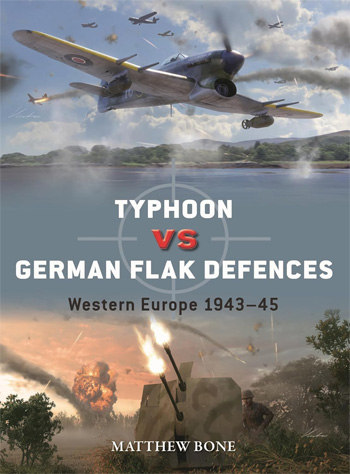
Coming soon from Osprey Publishing and author Matthew Bone is Typhoon vs German Flak Defences: Western Europe 1943–45, an illustrated study of the evolving tactics that powered the deadly clashes between the RAF’s Typhoon Mk IB fighter-bomber and the Flakwaffesdefendinganti-aircraftarsenal.

The Flakwaffe’s role was to protect the Wehrmacht’s men, machines and material from aerial attack. Opposing them was the RAF’s 2nd Tactical Air Force (TAF), whose fighter-bomber spear was tipped with the Typhoon Mk IB, a fighter modified beyond its original intent. The tactics and weaponry of both adversaries evolved as each sought to outdraw the other, with ‘Bombphoon’ and rocket Typhoon squadrons combining their efforts whilst the Flakwaffe laid deadly traps in fields and on trucks and railway wagons.

In this engrossing study, Typhoon expert Matthew Bone chronicles the exploits of the 2nd TAF’s fighter-bombers and the Flakwaffe arsenal into whose crosshairs they ventured. Drawing on contemporary records of Typhoon operations and historical details of Flak crews, this detailed account utilises newly commissioned artwork, maps and diagrams to shed fresh light on the tactical development of both sides, and the price the RAF ultimately paid for victory.

The 80 page, paperback book is currently available for pre-order with release set for April 29.

Product Page

Please Note: This post contains an Amazon affiliate link. When you purchase through links on our site, we may earn an affiliate commission.
Posted on

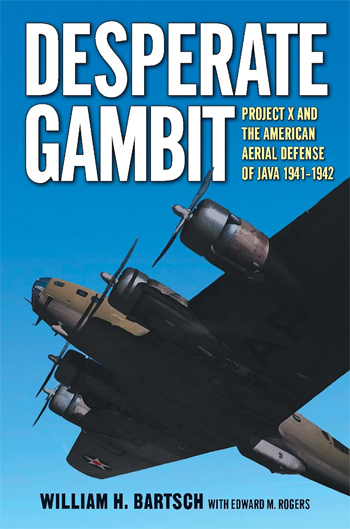
Project X and the American Aerial Defense of Java, 1941–1942

Coming soon from Texas A&M University Press and authors William H. Bartsch and Edward M. Rogers is Desperate Gambit: Project X and the American Aerial Defense of Java, 1941–1942, which reveals the untold story of how the Army Air Forces sent some eighty B-17 Flying Fortresses nearly 7,000 miles to Java to oppose the Japanese invasion.

In the dark days of World War II, just after Pearl Harbor, Japanese forces were moving almost at will across Southeast Asia and the Pacific. With his troops besieged in the Philippines and his bomber and fighter squadrons decimated, General MacArthur pressured the US War Department to provide urgent help, particularly for replacements for the B-17 bombers devastated in the December 8 attack on Clark Field. President Roosevelt committed to send a large force of heavy bombers and their crews to the Philippines, a reinforcement plan code named “Project X.” Continue reading Project X and the American Aerial Defense of Java, 1941–1942

Please Note: This post contains an Amazon affiliate link. When you purchase through links on our site, we may earn an affiliate commission.
Posted on

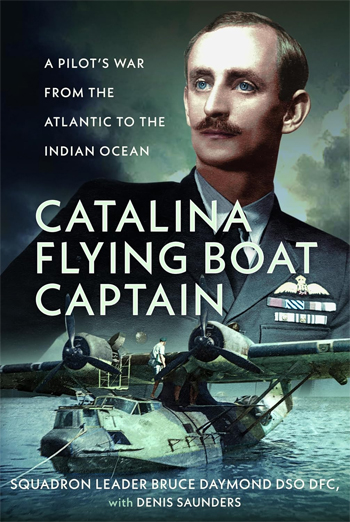
Catalina Flying Boat Captain: A Pilot’s War from the Atlantic to the Indian Ocean

Coming soon from Air World and author Denis Saunders is Catalina Flying Boat Captain: A Pilot’s War from the Atlantic to the Indian Ocean. The book is a survivor’s wartime voyage, chronicling long, perilous Catalina flights / missions, and steadfast leadership amid oceanic dangers and relentless duty.

Aged 21, Bruce Daymond enlisted in the Royal Australian Air Force in 1941. He had joined to serve the British Empire, as it then was, knowing he would serve thousands of miles from Australia.

Sixteen days into my flying training, Bruce went solo for the first time. Having trained as pilot and navigator under the Empire Air Training Scheme, in both Australia and Canada, he went on to serve in the RAF throughout the Second World War. As a pilot of a Consolidated Catalina flying boat, he flew with a number of Coastal Command units, namely Nos. 209, 357, 628, and 240 squadrons. Throughout his service, Bruce maintained a huge, detailed, candid, and personal daily diary; it is that which forms the basis of this insightful account of one flying boat captain’s service. The result is a revealing account of one man’s dedication to service and leadership, endurance of hundreds of hours of monotonous flying interspersed with periods of terror and courage in the face of great danger. Continue reading Catalina Flying Boat Captain: A Pilot’s War from the Atlantic to the Indian Ocean

Please Note: This post contains an Amazon affiliate link. When you purchase through links on our site, we may earn an affiliate commission.
Posted on

Battle of Britain Memorial Flight’s 60th Anniversary Celebrated With Updated Pictorial History

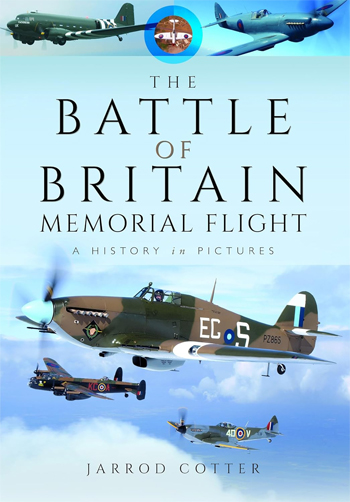
Coming soon from Pen & Sword Aviation and author Jarrod Cotter is The Battle of Britain Memorial Flight: A History in Pictures, an updated new edition to celebrate their 60th anniversary.

In 2007 the Battle of Britain Memorial Flight celebrated its landmark 50th anniversary and Jarrod Cotter was chosen to write a book charting the Flight’s history which began with the formation of the Historic Aircraft Flight in July 1957. This volume brings the story fully up-to-date to mark the BBMF s 60th anniversary. It still includes the in-depth story of the formation of the Flight, for which the author uniquely traced the families of those involved to reveal a host of illuminating insights. However, while the 50th anniversary book went on to tell the rest of the story in an in-depth fashion, this volume utilises high quality colour digital photographs taken in recent years to show the aircraft in flight and so acts as the perfect companion to the first volume. This will be the ultimate souvenir of the celebration of the BBMF s 60th anniversary.

The 304 page, hardcover book is currently available for pre-order with release set for October 30.

Product Page

Please Note: This post contains an Amazon affiliate link. When you purchase through links on our site, we may earn an affiliate commission.
Posted on

Okinawa 1945 Examined in Fully Illustrated, Expertly Researched New Study

Coming soon from Osprey Publishing and author James S. Corum is Okinawa 1945: The epitome of joint US airpower in the Pacific, described as the first book to examine US Pacific War tactical airpower at its peak, in the last and greatest island campaign.

The battle for Okinawa turned out to be the last major campaign of World War II, and the largest amphibious invasion of the Pacific War. After years of improvement, Okinawa saw American tactical aviation at its most effective, yet little has been written about how the huge and complex air operation here was organized and fought.

In this book, airpower scholar James S. Corum presents a full portrait of US Navy, Marine and Army Air Force aviation in the battle for Okinawa. Unique to the campaign was the formation of a Marine-commanded Tactical Air Force to support the Army-Marine Tenth Army, which provided the ground forces battling for the island with unparalleled close air support, with only ten recorded instances of friendly fire from 14,000 sorties. He also examines air operations flown from Okinawa after the surrender, and provides an overview of the planned air support for the invasion of the Home Islands from Okinawa.

Fully illustrated with superb original artwork, 3D diagrams and maps, this is an expertly researched study of the ultimate tactical air campaign of the Pacific.

The 96 page, paperback book is currently available for pre-order with release set for November 17.

Product Page

Please Note: This post contains an Amazon affiliate link. When you purchase through links on our site, we may earn an affiliate commission.
Posted on

Helmut Lent’s Logbook: The Combat Service of One of the Top-Scoring Night Fighter Aces of All Time

Coming soon from Air World and author Chris Goss is Helmut Lent’s Logbook: The Combat Service of One of the Top-Scoring Night Fighter Aces of All Time, which chronicles his rise from day fighter to radar-guided interception while detailing pivotal battles over Europe and his leadership in nocturnal air combat.

Credited with 110 aerial victories, Helmut Lent was one of the most successful German night-fighter aces of the Second World War. Born on 13 June 1918, he initially served as a day fighter pilot in the Luftwaffe, flying Messerschmitt Bf 110s during the early campaigns of the war.

Lent’s combat career began over the North Sea, Norway and the early stages of the Battle of Britain but in September 1940 his unit transitioned to night fighting. As part of Nachtjagdgeschwader 1, after initial self-doubts as to his ability, he established himself as a formidable night-fighter pilot, adapting to the emerging technology of radar-guided interception. His aircraft of choice was the Messerschmitt Bf 110 but in 1944 he flew the Junkers Ju 88, both of which he used to devastating effect against Allied bombers conducting night attacks over German territory; of his 110 victories, 102 had taken place at night.

By 1943, Lent had risen through the ranks, eventually taking command of Nachtjagdgeschwader 3, and would receive numerous decorations, including the Knight’s Cross of the Iron Cross with Oak Leaves, Swords, and Diamonds, Germany’s highest military honour. He was the first night fighter pilot to receive this award, defining his status as a leading figure in aerial combat at night.

Lent’s career was cut short on 5 October 1944, when his Ju 88 crashed on landing in an accident. He succumbed to his injuries two days later at the age of 26. Such was his standing in the eyes of the Luftwaffe, that Reichsmarschall Hermann Göring spoke at his funeral. Continue reading Helmut Lent’s Logbook: The Combat Service of One of the Top-Scoring Night Fighter Aces of All Time

Please Note: This post contains an Amazon affiliate link. When you purchase through links on our site, we may earn an affiliate commission.

Posted on

Red Baron’s 80 Victories Recreated in “Lavishly Illustrated” New Book

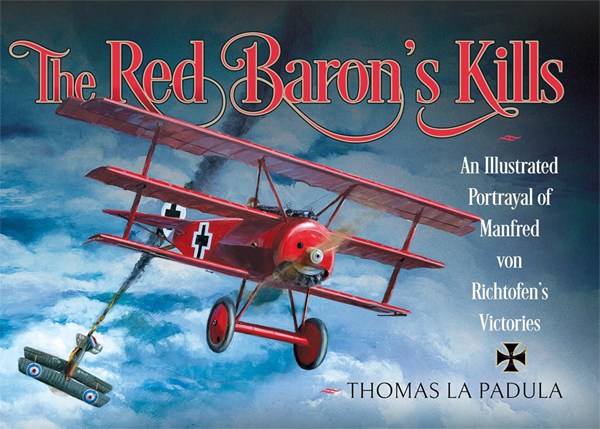
Coming soon from Pen and Sword Military and author Thomas La Padula is The Red Baron’s Kills: An Illustrated Portrayal of Manfred von Richthofen’s Victories, a lavish, illustrated study that recreates combat moments and varied aircraft through original artwork and clear, graphic timelines.

…Using original source material the author recreates the moment in combat when the Red Baron shot down each of his victories to make him the leading ace of the First World War. Of special interest is the fact that the Red Baron flew a variety of aircraft other than his famous all red Fokker Dr.l. triplane. The paintings will provide a visual scene along with descriptive text to explain the situations behind each victory or kill in a clear, graphic timeline.

The 192 page, hardcover book is currently available for pre-order with release set for November 30.

Product Page

Please Note: This post contains an Amazon affiliate link. When you purchase through links on our site, we may earn an affiliate commission.

Posted on

Spitfires over Tokyo: Commonwealth Air Forces in Japan 1945–1948

Coming soon from Fonthill and author Simon Gifford is Spitfires over Tokyo: Commonwealth Air Forces in Japan 1945–1948.

In the spring of 1946, the Royal Air Force, Royal Australian Air Force, Royal Indian Air Force and Royal New Zealand Air Force dispatched aircraft and men to form the air element of the British Commonwealth Occupation Force of Japan. Equipped with Spitfire XIVs, P51D Mustangs and FG-1D Corsairs, seven squadrons of fighter aircraft spent the next two years backing up the American forces in the successful disarmament of Japan and the country’s transition to a democratic nation. Supporting the fighters were RAF, RAAF, RNZAF Dakotas, which flew numerous sorties linking the forces in Japan to Hong Kong, Australia and New Zealand. Other aircraft flown in Japan included Austers, Ansons, Harvards and Wirraways.

Spitfires over Tokyo: Commonwealth Air Forces in Japan 1945–1948 traces the formation of the occupation force, including the formation of the Spitfire squadrons in India, through their helping liberate Malaya, Singapore and Hong Kong, and on to their final disbandment in Japan and the end of occupation duties in 1948. Profusely illustrated with photos of all of the aircraft flown in Japan, the majority of which have not been published previously, the book offers an illuminating window on a little-known area of post-war aviation history.

The 264 page, hardcover book is currently available for pre-order with release set for January 30, 2027.

Product Page

Please Note: This post contains an Amazon affiliate link. When you purchase through links on our site, we may earn an affiliate commission.
Posted on

Interceptor! Spitfires to Foxbats: The Story of the World’s Finest Pursuit Aircraft

Coming soon from Key Publishing Ltd and author David Baker is Interceptor! Spitfires to Foxbats: The fastest chase planes with seconds to launch, which celebrates the fastest, most aggressive fighter aircraft ever built – the interceptors.

These are the aircraft designed to launch quickly, climb fast and catch intruders before they could strike – from Cold War nuclear bombers to modern cruise missiles. From the elegant Spitfire Mk XIV and the brutal MiG-25 Foxbat to the F-106 Delta Dart and F-14 Tomcat, this title tells the story of the world’s finest pursuit machines – how they were developed, how they flew, and how they fought.

The 116 page paperback publication is currently available for pre-order with release set for September 10.

Product Page

Please Note: This post contains an Amazon affiliate link. When you purchase through links on our site, we may earn an affiliate commission.
Posted on

New Two Volume Series Details Vickers Aircraft of WW1 With Drawings, Photos, Color Profiles

Newly released from Aeronaut Books and author is Colin Owers is a two volume series on Vickers aircraft of WW1:

The story of how the Vickers, Sons and Maxim Ltd, heavy armament manufacturers, entered aeronautical manufacturing when the military potential of aviation became apparent, is told in these two volumes. Vickers aircraft were soon flying, originally being based on the French REP monoplane. Then in 1913 they exhibited what could well be the first British aircraft designed from the start as a fighting machine with a forward firing machine gun. This was developed into the F.B.5, better known as the ‘Gun Bus’. They were in service as soon as the war broke out in 1914 and for a while were successful. The advent of the synchronised machine gun fighter saw Vickers machines fall out of favour. They built many interesting prototypes but only three were manufactured in small series.

The Company produced some of the fastest aircraft of their time and in a civil world would have achieved fame; however, they were not suited to the evolving aerial battlefield. The Vimy bomber of 1918 was a sensation, lifting a greater bombload the Handley Page O/400 on less power. The end of hostilities meant that no Vimy flew on operations in WWI but it went onto a long career in the RAF and in civil hands in its Vernon version.

The story of this remarkable company is told in detail including contemporary drawings from official manuals and reports. Volume 1 has 182 photos, 30 color profiles, and scale drawings of 3 aircraft in its 207 pages. Volume 2 has 221 photos, 33 color profiles, and scale drawings of 3 aircraft within its 214 pages.

The two volumes, Vickers Aircraft of WWI: Volume 1: E.F.B – F.B.12 and Vickers Aircraft of WWI: Volume 2: F.B.14 – Valentia Flying Boat are currently available in paperback format.

Product Page (Volume 1)
Product Page (Volume 2)

Please Note: This post contains an Amazon affiliate link. When you purchase through links on our site, we may earn an affiliate commission.