
Posted on

New Official History Details RAF Decoys and Visual Deception of German Bombers in WW2

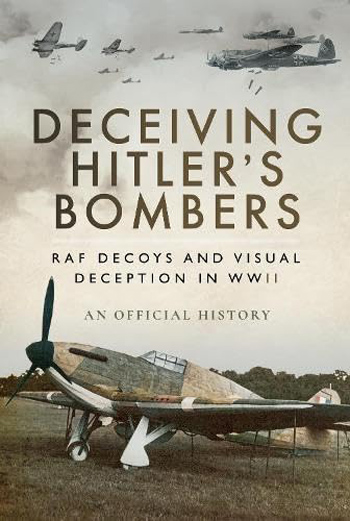
Coming soon from Air World is Deceiving Hitler’s Bombers: RAF Decoys and Visual Deception in WWII, which is an official history of clever visual deception―dummy sites, fake lights, and camouflage―to mislead German bombers and protect key locations during WW2.

The first, and most essential element in aerial bombardment is that of locating the target. All the inherent costs and risks in undertaking a bombing raid are of no avail unless the objective of the mission is correctly identified. If, through means of decoys or visual deception, the attacking aircraft can be tricked into dropping their deadly payloads in areas of little importance to the general war effort, the enemy bombers will have failed in their mission.

It was accepted at the start of the war that enemy bombers would always get through the UK’s defences and that the German bomber crews could be expected to have a reasonable understanding of Britain’s geography and of its main industrial and military facilities. That being the case, how could the most important sites be protected? Continue reading New Official History Details RAF Decoys and Visual Deception of German Bombers in WW2

Please Note: This post contains an Amazon affiliate link. When you purchase through links on our site, we may earn an affiliate commission.
Posted on

New Guinea Eagles: The Japanese Air Army Campaign in New Guinea 1942-43

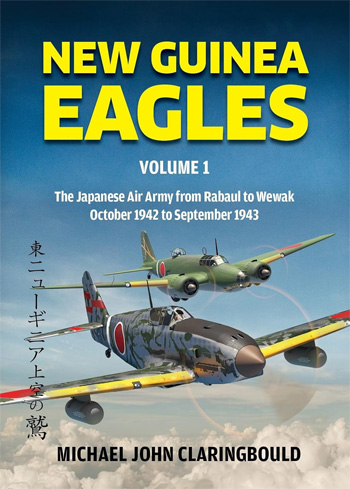
Coming soon from Avonmore Books and author Michael Claringbould is New Guinea Eagles Volume 1: The Japanese Air Army from Rabaul to Wewak October 1942 to September 1943, which chronicles the Japanese Air Army campaign in New Guinea from when its first units arrived in October 1942 until the late September 1943 raids against Nadzab and Port Moresby.

Never before have the rationale, activities and losses of JAAF air power in New Guinea been chronicled in such detail and accuracy. The force operated an impressive range of aircraft types but found it much easier to commit than withdraw from the challenging theatre.

This volume covers Rabaul’s and Wewak’s beginnings as major JAAF bases. The period involved guarding supply convoys, attacking Wau and two major forays into the Solomons. Then by mid-1943 the Allied air war had gravitated towards the burgeoning JAAF airfield complexes spreading out along New Guinea’s northern coast. Two air divisions were combined to create the 4th Air Army in August 1943, and its aircraft soon ventured into the New Guinea Highlands before defending Nassau Bay, Lae and Salamaua. Continue reading New Guinea Eagles: The Japanese Air Army Campaign in New Guinea 1942-43

Please Note: This post contains an Amazon affiliate link. When you purchase through links on our site, we may earn an affiliate commission.
Posted on

Bomber Crew Escaper: A Wartime Airman’s Fight for Survival and Freedom

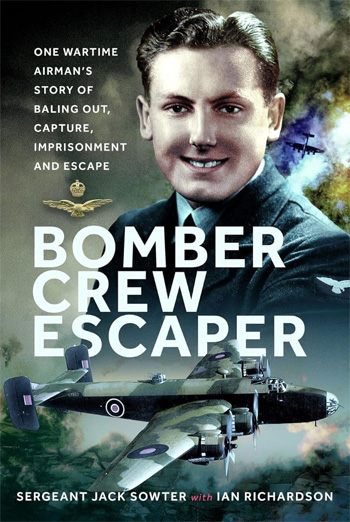
Coming soon from Air World and authors Jack Sowter and Ian Richardson is Bomber Crew Escaper: One Wartime Airman’s Story of Baling Out, Capture, Imprisonment and Escape

Sergeant Jack Sowter had joined the RAF in October 1941, originally as a trainee wireless operator. He later re-mustered as a navigator and joined the crew of a Handley Page Halifax of 78 Squadron.

On the night of 27/28 July 1943, Jack’s aircraft, JD 148, was one of 787 bombers tasked with attacking the port of Hamburg as part of Operation Gomorrah. Having successfully unleashed its deadly load on the German city, Jack’s captain, Sergeant Les Maidment, turned for home. However, Maidment could not escape the penetrating beams of the German searchlights, nor the enemy flak. With his aircraft repeatedly hit, Maidment gave his crew the order to bale out. Continue reading Bomber Crew Escaper: A Wartime Airman’s Fight for Survival and Freedom

Please Note: This post contains an Amazon affiliate link. When you purchase through links on our site, we may earn an affiliate commission.

Posted on

Follow the 9th Bomb Squadron Into WW2’s Most Dangerous Flying Conditions

Coming soon from McFarland Publishing and author Charles B. Kastner is To War and Back with the 9th Bomb Squadron: In the Skies Over Burma, Thailand, and China in 1945:

Written by his son, and incorporating his father’s stories, personal papers, and original research, this work follows Lt. Walt Kastner from the start of World War Two until its end. Walt joined a new B-24 bomber crew that fought with the 9th Bomb Squadron from its base in India during the drive to liberate Burma from the Japanese Army. His air crew attacked Japanese troop concentrations that barred the advance of the British 14th Army and flew missions deep into Thailand, including attacking the Burma-Siam Railway, the crucial rail link that carried supplies that fed and equipped the Japanese Army in Burma–a railway made famous by the movie The Bridge on the River Kwai. When air combat ended in May 1945, the squadron moved to Assam in eastern India where they hauled aviation gasoline over “the Hump” to the 14th Air Force in China, exposing them to the most dangerous flying conditions in the world.

The 155 page book is currently available for pre-order with release set for August 21.

Product Page

Please Note: This post contains an Amazon affiliate link. When you purchase through links on our site, we may earn an affiliate commission.
Posted on

New Book Chronicles Perilous Work of USAF Combat Cameramen

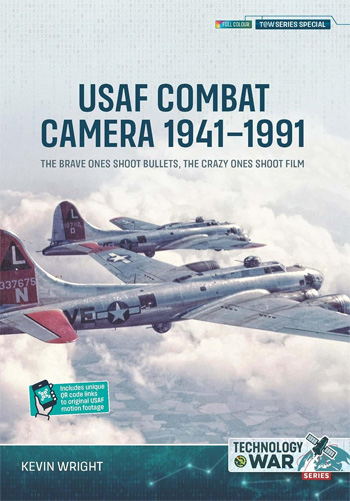
Coming soon from Helion and Company and author Kevin Wright is USAF Combat Camera 1941–1991: The Brave Ones Shoot Bullets, the Crazy Ones Shoot Film, documenting USAF cinematographers and photographers and their frequently hazardous work.

USAF Combat Cameramen and later women have participated in every major US military operation and deployment worldwide. Whilst some of their wartime productions like the original Memphis Belle and The Last Bomb, rightly gained wide public acclaim, the vast majority of their work, often classified, was for the Pentagon’s eyes only. Their main role was to keep senior military commanders and decision-makers informed about USAF operations and to record the challenges faced by US armed forces on the ground.

Combat Camera charts those activities from their origins in Hollywood, producing military training films, through wartime movies, bomber operations over Europe and Japan, the liberation of France, the attacks on Hiroshima and Nagasaki, to Korea, Vietnam, Grenada, Panama and the 1991 Gulf War.

These events are explored mainly through personal accounts from the combat cameramen and women themselves. From acts of individual heroism, through organisational change, new equipment and their often ringside seats at historic events, Combat Camera captures the work of these remarkable men and women and has been produced with cooperation of the membership of the USAF Combat Camera Association.

This volume is profusely illustrated with original photographs and includes unique links to original motion footage shot by the USAF Combat Cameramen, in addition to the @War series signature colour artworks.

The 72 page paperback publication is currently available for pre-order with release set for June 15.

Product Page

Please Note: This post contains an Amazon affiliate link. When you purchase through links on our site, we may earn an affiliate commission.
Posted on

The Observer Corps: The Hidden Defenders Tracking Enemy Aircraft in Britain’s Skies

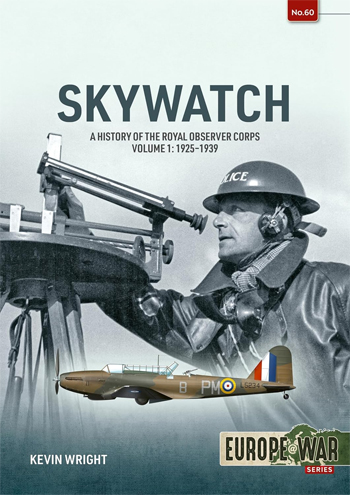
Soon to be released by Helion and Company and author Kevin Wright is Skywatch Volume 1: A History of the Royal Observer Corps, 1925 to 1939.

During World War One, London was vulnerable to air attacks by Zeppelins and later German bombers. To defend the capital, the London Air Defence Area was created to coordinate the efforts to protect it. However, after 1918, the system was quickly abandoned.

In the early 1920s, the Committee for Imperial Defence began to reconsider the problem. In 1924, the first experiment was conducted to monitor and report the movement of aircraft overland by using small groups of aircraft observers reporting to a central point. This successful experiment led to the creation of the Observer Corps in 1925 under the control of Police Chief Constables.

Originally intended to cover just the South East of England to protect London, as the threat from resurgent Nazi Germany grew, the Corps was gradually expanded to cover nearly the whole of Gt Britain by the start of the War. Now transferred to the control of the Air Ministry, Observer Corps Groups became a key part of Fighter Commands integrated air defence system, unique in that it was the only means to track the movement of aircraft once they crossed the coast and headed inland.

Using a combination of new research and access to official files, Volume One of Skywatch charts the development of the Observer Corps from its origins, the very beginnings, formation and growth through the 1920s. It critically examines how, in the rush to prepare for War in the late 1930s, the Observer Corps began to ready itself for War and its unique role, monitoring the skies of Britain.

The 76 page publication is currently available for pre-order in paperback format. Release is slated for April 30.

Product Page

Please Note: This post contains an Amazon affiliate link. When you purchase through links on our site, we may earn an affiliate commission.

Posted on

Pacific Turning Point: Airpower in New Guinea 1943–44

Coming soon from Osprey and authors Mark Stille and John Rogers is New Guinea 1943–44: The Allies assume the offensive, a fully illustrated history of airpower in the decisive stage of the New Guinea campaign, when the Allies could finally go on the offensive to shatter Japanese forces.

In this book, the second of two on the New Guinea campaign, Pacific War scholars Mark Stille and John Rogers draw upon years of research and Japanese, American and Australian sources to explain how the New Guinea air war turned against the Japanese between June 1943 and 1944. The over-extended IJAAF gradually lost combat strength in the face of vastly improved Allied airpower, leaving the Japanese unable to contend. One prong of the Allies’ air offensive targeted Japanese shipping to isolate its forces, while the other supported the ground offensives and landings that smashed Japanese forces and left most of them isolated for the rest of the war.

Packed with artwork, maps, and archive photos, this book explains how the lessons learned and the forces built up during the harsh struggle for Papua in 1942–43 transformed the Allies’ airpower into a decisive element in MacArthur’s 1943–44 campaign.

The 96 page publication is currently available for pre-order in paperpack and Kindle editions. Release is set for August 25.

Product Page

Please Note: This post contains an Amazon affiliate link. When you purchase through links on our site, we may earn an affiliate commission.
Posted on

New Release: Solomon’s Air War Vol. 4 — The Epic Evacuation of Guadalcanal

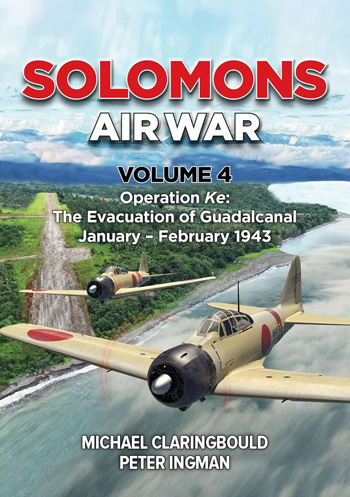
Coming soon from Avonmore Books and authors Michael Claringbould and Peter Ingman is Solomons Air War Volume 4: Operation Ke: The Evacuation of Guadalcanal January – February 1943, which sheds new light on hitherto little-known or misunderstood episodes in the Pacific air war.

This fourth volume of Solomons Air War chronicles aerial warfare throughout the Solomons theatre during the months of January and February 1943. It can be read alone or as part of the ongoing Solomons Air War series. This crucial period saw the Japanese swallow a bitter pill and launch Operation Ke, which was the evacuation of Guadalcanal. It was a complex operation conceived under utmost secrecy, which then unfolded over several weeks. Included was a widespread air offensive that saw the Japanese Army Air Force in the Solomons for the first time. Ironically, this operation was arguably the most successful yet for the Japanese in the theatre.

Against this background the intense air campaign continued. Enjoying a secure foothold on Guadalcanal and ever-growing facilities, Cactus Air Force expanded and pushed operations northwards into the Solomons chain where the Japanese were operating from Munda and building a new airfield at Vila. Temporary reinforcements were provided by carrier squadrons from both sides operating from land bases, including for the first time air units from USN escort carriers. Continue reading New Release: Solomon’s Air War Vol. 4 — The Epic Evacuation of Guadalcanal

Please Note: This post contains an Amazon affiliate link. When you purchase through links on our site, we may earn an affiliate commission.
Posted on

Into the Nuclear Cloud: A Cold War Pilot’s Story

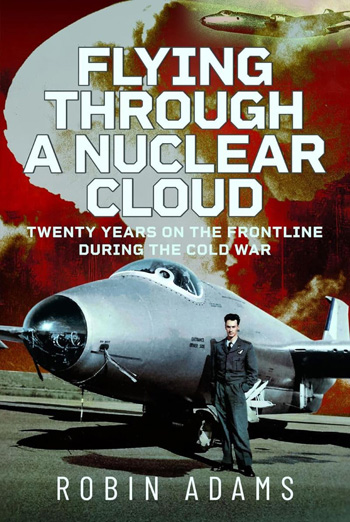
Coming soon from Air World and author Robin Adams is Flying Through a Nuclear Cloud: Twenty Years on the Frontline During the Cold War, which tells the unusual story of a frontline navigator who flew on Canberra, Shackleton and F4 Phantom squadrons between 1954 and 1974 as well as his involvement with nuclear weapon testing in 1956 and 1958.

It was during his time on Canberras that, in 1955, volunteers were called for ‘An Interesting Overseas Tour’. Robin Adams put his hand up. The task was to collect samples resulting from nuclear explosions. This, however, was only revealed to the volunteers after they had arrived in Australia.

On 19 June 1956 that Robin, then the navigator of Canberra WH976, took off from the RAAF Perth. Along with his pilot, Robin was about to be involved in the second and final nuclear test under Operation Mosaic – both explosions taking place at the Montebello Islands.

In 1957 Robin joined Coastal Command flying the Avro Shackleton. After this interlude, a year later he was back nuclear testing. This time it was at Christmas Island in the Pacific, with the awesome megaton H bombs of Operation Grapple Z. His task was to collect weather data and clear shipping from the potential danger areas. From 1963-1966 Robin was on 31 Squadron which, equipped with Canberra PR.7s, was stationed in Germany and tasked with day and night low-level photo reconnaissance. It was during this time that he was involved in a serious aircraft accident following a single engine approach at night.

By 1969 the front-line days were over for the Canberra, and Robin was posted onto the F4 Phantom as a Flight Commander on 14 Squadron. The squadron’s primary role was all-weather tactical nuclear weapon delivery to targets in East Germany, secondary roles being ground attack and air defence. Crews stood Quick Reaction Alert for twenty-four hour stretches, twice a month, in a hut, with a nuclear weapon loaded on the aircraft parked outside. Robin’s nuclear journey had gone full circle.

The 256 page hardcover book is currently available for pre-order with release slated for March 30.

Product Page

Please Note: This post contains an Amazon affiliate link. When you purchase through links on our site, we may earn an affiliate commission.
Posted on

From Biplanes to Jets: The RAF’s Long Watch in the Far East

Newly released from author Steve Bond and Grub Street Publishing is RAF Boys in the Far East: True Tales of the RAF in India, South East Asia and Hong Kong.

For 82 years the Royal Flying Corps (RFC), which in 1918 became the Royal Air Force (RAF), maintained a permanent military aviation presence in the Far East. Throughout that time a huge variety of squadrons, flying many different aircraft types, together with all the necessary operational, technical and administrative support, took on all that was asked of them. The first RFC units arrived in India in 1915. RAF India grew substantially in the interwar period and throughout World War Two. Various changes in the command structure finally saw the creation of the Far East Air Force (FEAF) in June 1949, covering South East Asia and Hong Kong. In the 1960s the UK government decided to withdraw all forces East of Suez and on 31 October 1971 the FEAF disbanded and most UK forces withdrew from Singapore at this time. The last RAF unit to leave the region was 28 Squadron flying. They had been operating Whirlwind and Wessex helicopters in Hong Kong until the territory was handed back to China in 1997. RAF Boys in the Far East illustrates what it was like for those air and ground crew who were there by telling their stories in their own words, supported by explanation of the situations at the time and photographs primarily drawn from veterans’ own collections. The stories are as varied as the locations, the units and the personnel; everyday operations, exercises, triumph and tragedy, off duty time, and of course, the humour for which the RAF is renowned. Chapters focus on differing aircraft roles and their operations, including emphasis on the war years in India and Burma, and the Singapore era with actions such as Operation Firedog and the Indonesian Confrontation. Today those veterans who look back on their time served in the FEAF do so with a great deal of pride, and rightly so. This is their story.

The 256 page book is available in hardcover, Kindle and audiobook editions.

Product Page

Please Note: This post contains an Amazon affiliate link. When you purchase through links on our site, we may earn an affiliate commission.