
Posted on

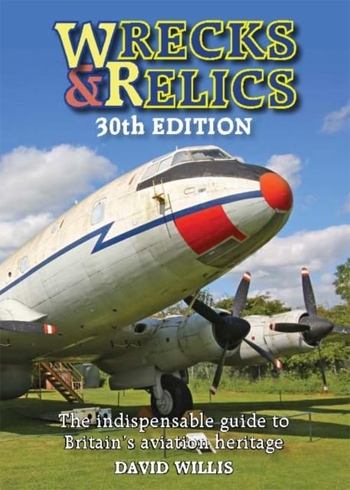
Wrecks & Relics 30th Edition: The Indispensable Guide to Britain’s Aviation Heritage

Coming soon from Crecy Publishing and author David Willis is Wrecks & Relics 30th Edition: The indispensable guide to Britain’s aviation heritage, A comprehensive, illustrated guide that chronicles more than 700 locations and 4,000 aircraft across the British Isles, detailing histories, current statuses, and where to explore preserving aviation heritage.

Wrecks & Relics remains the only publication required to discover the incredible aeronautical treasures found across the UK and Ireland. It provides a trusted, comprehensive rundown of museums and collections and their exhibits – static or flying – together with workshops, military ‘gate guardians’, stored and instructional airframes etc. It also reveals redundant and even derelict airframes being used for the most unlikely of purposes, including ‘glamping’ and at paint-ball sites.

Each edition of Wrecks & Relics is profusely illustrated with both colour and black and white photographs and is fully indexed making easy the task of where to go over the weekend, or where to find an extant example of a favourite aircraft type. Whether it travels in the car or sits on the bookshelf, this new and fully revised edition of this classic publication will continue to be the most useful and accurate companion to the aviation heritage of the British Isles, which will be referred to again and again.

The 392 page, hardcover book is currently available for pre-order with release set for August 26.

Product Page

Please Note: This post contains an Amazon affiliate link. When you purchase through links on our site, we may earn an affiliate commission.

Posted on

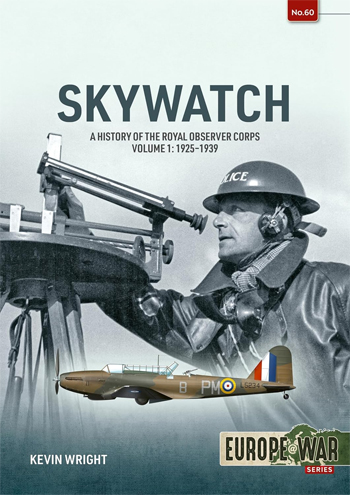
The Observer Corps: The Hidden Defenders Tracking Enemy Aircraft in Britain’s Skies

Soon to be released by Helion and Company and author Kevin Wright is Skywatch Volume 1: A History of the Royal Observer Corps, 1925 to 1939.

During World War One, London was vulnerable to air attacks by Zeppelins and later German bombers. To defend the capital, the London Air Defence Area was created to coordinate the efforts to protect it. However, after 1918, the system was quickly abandoned.

In the early 1920s, the Committee for Imperial Defence began to reconsider the problem. In 1924, the first experiment was conducted to monitor and report the movement of aircraft overland by using small groups of aircraft observers reporting to a central point. This successful experiment led to the creation of the Observer Corps in 1925 under the control of Police Chief Constables.

Originally intended to cover just the South East of England to protect London, as the threat from resurgent Nazi Germany grew, the Corps was gradually expanded to cover nearly the whole of Gt Britain by the start of the War. Now transferred to the control of the Air Ministry, Observer Corps Groups became a key part of Fighter Commands integrated air defence system, unique in that it was the only means to track the movement of aircraft once they crossed the coast and headed inland.

Using a combination of new research and access to official files, Volume One of Skywatch charts the development of the Observer Corps from its origins, the very beginnings, formation and growth through the 1920s. It critically examines how, in the rush to prepare for War in the late 1930s, the Observer Corps began to ready itself for War and its unique role, monitoring the skies of Britain.

The 76 page publication is currently available for pre-order in paperback format. Release is slated for April 30.

Product Page

Please Note: This post contains an Amazon affiliate link. When you purchase through links on our site, we may earn an affiliate commission.