Posted on

Fw 190 Schlacht Units: An Illustrated History of the “Tank-Buster” and its Operations

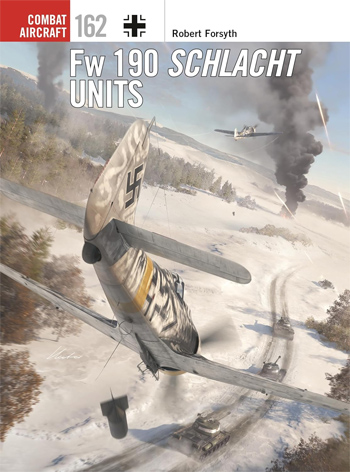
Coming soon from Osprey Publishing and author Robert Forsyth is Fw 190 Schlacht Units (Combat Aircraft, 162), an illustrated account of the Fw 190 “tank-buster” and its operations on the Eastern, Western and Mediterranean Fronts from 1942–45.

The Fw 190 offered the Luftwaffe a reliable successor to the Ju 87 Stuka, able to operate from primitive forward airfields in both the freezing winters of the Soviet Union and the desert heat of North Africa. Converted by Focke-Wulf from a radial-engined fighter into a deadly fighter-bomber and ground-attack aircraft, it used its aerial gun platform, wide-tracked undercarriage and powerful BMW engines to devastating effect on the Eastern, Western and Mediterranean Fronts between 1942 and 1945.

In this new study, leading Luftwaffe historian Robert Forsyth examines all aspects of the Fw 190 and its career as a ‘tank-buster’, detailing the considerable damage it wrought upon Allied armour, troop concentrations, bridges and road junctions. First-hand accounts from Schlachtflieger pilots bring to life the operational and tactical histories of the aircraft, and are complemented by archive photos and newly commissioned artwork that vividly demonstrates its technical and ballistic assets.

The 96 page book is currently available for pre-order in paperback and Kindle editions with release set for July 28.

Product Page

Please Note: This post contains an Amazon affiliate link. When you purchase through links on our site, we may earn an affiliate commission.

Posted on

Coming Soon: Illustrated Study of America’s Failed First Pacific Air Campaign

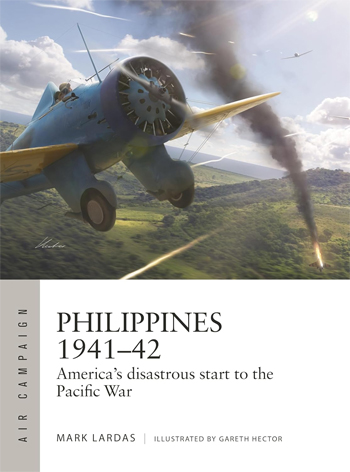
Coming soon from Osprey Publishing and author Mark Lardas is Philippines 1941–42: America’s disastrous start to the Pacific War, a fully illustrated study of the Pacific War’s little-known first major air campaign.

On December 7, 1941, the Japanese not only attacked Pearl Harbor, but also struck at US and allied bases throughout the Pacific, including the USA’s biggest overseas territory, the Philippines. However, that was an air battle the US was expecting. The USAAF had beefed up its assets in the Philippines, sending nearly a quarter of its available B-17s to the Far Eastern Air Force (FEAF).It could also call on the Philippine Army Air Corps (PAAC).

Aviation historian Mark Lardas explains how despite that, in a campaign that lasted barely a month, Japan’s air forces routed both the FEAF and the PAAC, gaining air superiority and permitting Imperial Army troops undisturbed access to the Philippine coast. Within a week Japan ruled the skies over Luzon. Two weeks later it had air superiority over all the Philippines. After a month, its control was so complete the Imperial Army felt confident to move its 5th Air Group back out of the Philippines. While desultory air combat would continue off and on for the next three months, the issue was decided by 5 January 1942.

Packed with original artwork, 3D diagrams, maps and photos, this is the history of how the first air campaign of the Pacific War turned into a humiliating defeat for the United States.

The 96 page publication is currently available for pre-order in paperback and Kindle editions with release scheduled for July 28.

Product Page

Please Note: This post contains an Amazon affiliate link. When you purchase through links on our site, we may earn an affiliate commission.
Posted on

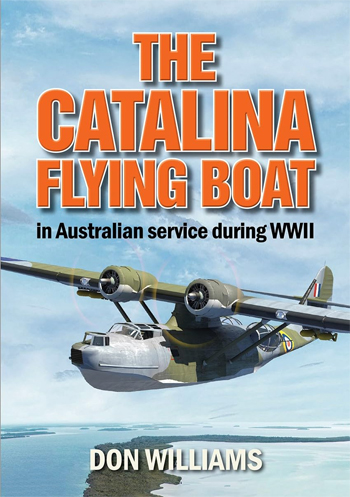
Catalina Flying Boat: The Complete Operational History in Australian Service

Coming soon from Avonmore Books and author Don Williams is The Catalina Flying Boat in Australian Service During WWII, a “full color, fully illustrated, complete operational history of the Catalina in Australian service during WWII, during which 225 airmen lost their lives.”

The RAAF effort during the Pacific War was massive, with glamorous types such as Spitfires, P-40s, Beaufighters and Hudsons grabbing most of the attention. While the ungainly Catalina flying boat played an equally important frontline role in the conflict, its contribution remains largely unheralded. Catalinas had unique characteristics and were in the combat zone from the first day of the war to the last, serving in several key roles. From the earliest desperate weeks of the Pacific War, RAAF Catalinas serving as bombers were one of the few Allied types with the range to strike the key Japanese base of Rabaul. Catalinas also monitored the enemy advance up to the Battle of the Coral Sea and paid a heavy price at the hands of Japanese fighters. From 1943 the Catalina force began expanding, and eventually 168 of the flying boats were received by the RAAF. These made a major strategic contribution to the war over the next two years, undertaking a successful minelaying campaign that ranged throughout the Netherlands East Indies and beyond as far as the Chinese coast. Catalinas also provided the RAAF with a valuable air-sea rescue capability, while others serving with Qantas maintained what was the longest regular airline route in the world between Perth and Ceylon.

The 132 page paperback publication is currently available for pre-order with release set for June 1.

Product Page

Please Note: This post contains an Amazon affiliate link. When you purchase through links on our site, we may earn an affiliate commission.
Posted on

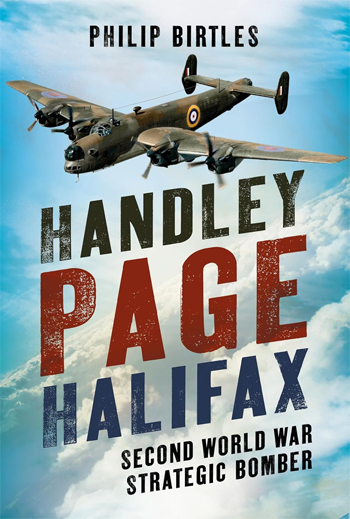
Handley Page Halifax: A Comprehensive Assessment

Coming soon from Fonthill Media and author Philip Birtles is Handley Page Halifax: Second World War Strategic Bomber, a comprehensive assessment of the aircraft, covering its design, production, testing and RAF service, both as a bomber and in its other roles.

While not as famous as the Avro Lancaster, the Handley Page Halifax was developed to the same specification as the Lancaster’s predecessor, the Avro Manchester, and suffered similar engine-related issues. However, once the early Rolls-Royce Merlins had been replaced with Bristol Hercules air-cooled radial engines, the bomber’s performance and reliability were transformed. The Halifax accounted for around 40 per cent of the RAF’s total heavy bomber fleet throughout the war, with production coming out of Handley Page at Cricklewood and Radlett, as well as English Electric at Samlesbury and Rootes Securities at Speke among other manufacturers located across Britain. After the engine change in 1943, the Halifax became a valued and reliable stablemate of the Lancaster, equipping two major Bomber Command Groups, including Canadian squadrons, and specialising in glider towing and maritime reconnaissance.

The 352 page, hardcover book is currently available for pre-order with release scheduled for May 30.

Product Page

Please Note: This post contains an Amazon affiliate link. When you purchase through links on our site, we may earn an affiliate commission.
Posted on

WW2 Aircraft on the Move at USAF Museum [Video]

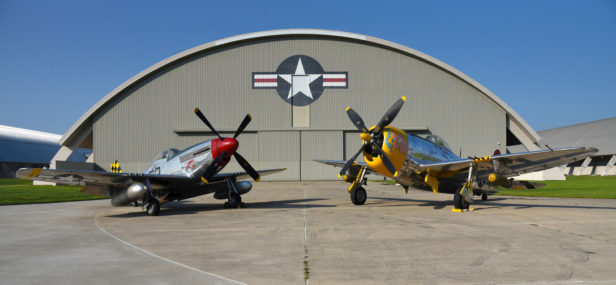
The USAF Museum in Dayton, Ohio recently moved some of its iconic WW2 warbirds back into position after they were temporarily relocated to provide room for the Memphis Belle exhibit opening back in May. These included the P-51, P-47, P-38 and A-36.

In the process, opportunities were provided to get a better look at the aircraft, resulting in a new series videos that can be seen below.

Continue reading WW2 Aircraft on the Move at USAF Museum [Video]