Posted on

New For June: Eduard’s “Weekend Edition” 1/48 MiG-21F-13

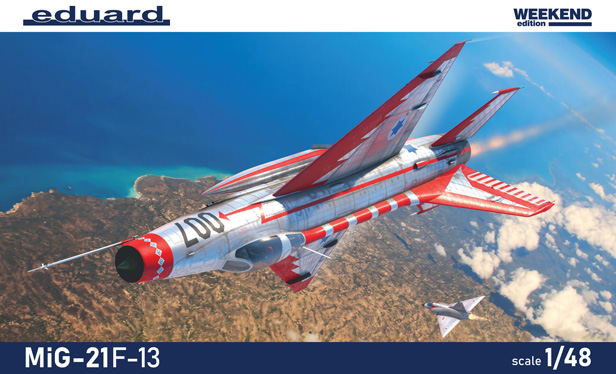
New this month from Eduard is a Weekend Edition MiG-21F-13 in 1/48 scale.

The MiG-21F-13 was the first widely produced version of the Soviet MiG-21 supersonic day interceptor introduced in 1960 and known to NATO as the Fishbed-C. It combined a lightweight tailed-delta design with Mach 2 performance, a simple weapons fit of a cannon and early infrared air-to-air missiles, and it became one of the most exported and long-lived fighter types of the Cold War.

The new kit (84213) offers Eduard plastic parts and decals with five marking options.

Buy on eBay

Please Note: This post contains an eBay affiliate link. When you purchase through links on our site, we may earn an affiliate commission.

Posted on

Coming Soon: An Illustrated History of BAC Lightning Units of the Cold War

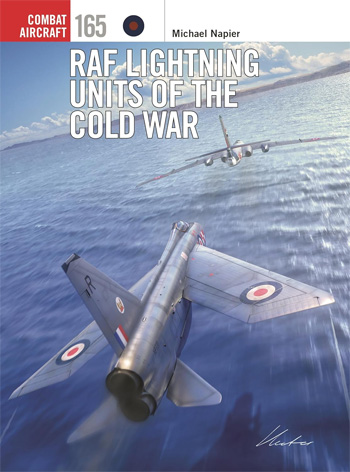
Coming soon from Osprey Publishing and author Michael Napier is RAF Lightning Units of the Cold War, an illustrated study of the Lightning Jet Fighter and its eventful operational history as the RAF’s star aircraft of the Cold War era.

The Mach 2-capable English Electric Lightning is perhaps the most iconic RAF aeroplane of the Cold War. Boasting a massive increase in performance and improved radar and weapons systems over its predecessors, the Lightning brought new capabilities to the RAF’s air defences. Tactics were adapted to fit the aircraft, including incorporating air-to-air refuelling as a routine part of operations because of the Lightning’s notoriously short range.

Retired fighter pilot Mike Napier draws on first-hand accounts from RAF aviators to tell the story of Britain’s ultimate Cold War jet fighter. Covering everything from the Lightning’s exercises with other NATO air forces to its interception of Soviet long-range ‘Badger’ and ‘Bear’ bombers in the late 1960s, this volume complements the aircraft’s colourful operational history with 20 profile artworks and photography from both official and personal archives.

The 96 page book is currently available for pre-order in paperback and Kindle editions with release set for February 16, 2027.

Product Page

Please Note: This post contains an Amazon affiliate link. When you purchase through links on our site, we may earn an affiliate commission.

Posted on

Cold War Air Thieves: Inside the Race to Steal Enemy Aircraft Secrets

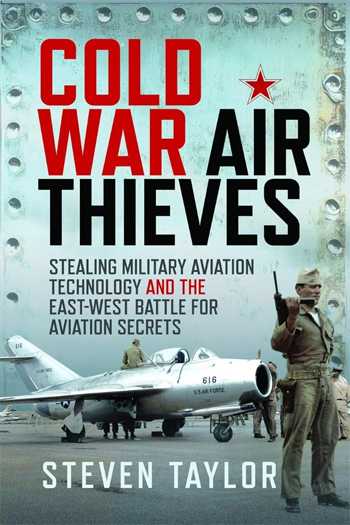
Coming soon from Pen & Sword and author Steven Taylor is Cold War Air Thieves: Stealing Military Aviation Technology and the East-West Battle for Aviation Secrets. The book provides the first in-depth exploration of the hidden Cold War battle fought by the intelligence services of both sides to obtain, by any means necessary, the secrets of some of the most potent warplanes ever to take to the skies.

The Cold War was a conflict defined by the battle for intelligence. And nowhere was this intelligence war more keenly fought than in the sphere of military aviation. Gaining information on the enemy’s latest warplanes and aviation-related hardware was a prime intelligence objective for both sides throughout the titanic ideological struggle that dominated the second half of the 20th century. Had the Cold War turned hot, the side possessing the greatest knowledge of its opponents’ combat aircraft would enjoy a crucial tactical advantage. Lagging behind the US and its NATO allies in many areas of aviation technology, the USSR also relied heavily on industrial espionage as a means of bridging the technological gap between East and West, shaving years and many millions of roubles off the development process in such key areas as the gas-turbine engine, long-range strategic bombers, air-to-air guided missiles, electronic countermeasures and stealth technology. Recruiting senior engineers and designers working in the opposing side’s aviation industries to spy for them, orchestrating the defection of pilots in their state-of-the-art aircraft, recovering shot-down aircraft wreckage from warzones like Korea, Vietnam and Afghanistan, even stealing components from under the noses of their enemies – nothing was off limits for the CIA, KGB, MI6 and Mossad in their relentless pursuit of aviation technology.

The 256 page hardcover book is currently available for pre-order with release set for August 30.

Product Page

Please Note: This post contains an Amazon affiliate link. When you purchase through links on our site, we may earn an affiliate commission.
Posted on

Avro Vulcan AEO Sets Out to Answer Common Cold War Question in New Book

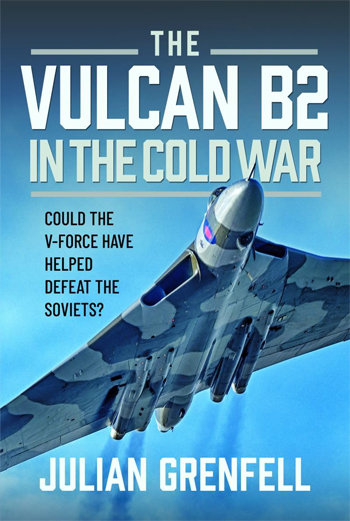
Coming soon from Air World and author Julian Grenfell is The Vulcan B2 in the Cold War: Could the V-Force Have Helped Defeat the Soviets. Written by an Air Electronics Officer with some 4,500 flying hours in Avro Vulcans, the new title sets out to answer the commonly asked question about Cold War V-force nuclear deterrent: “If the balloon had gone up, would it have got through?”

The Vulcan B2 in the Cold War analyses the state of air power in the early years of the Cold War, examining the hot wars of Korea and Vietnam, as well as the early versions of Soviet and Chinese air defence systems and how effective they might be at countering the RAF’s nuclear bomber fleet. The UK’s deterrent had to be survivable of a Soviet pre-emptive ballistic missile strike, or had to be airborne before such a strike took place. The early warning system provided Bomber Command’s headquarters with some 3½ minutes to 4½ minutes warning to get the V-force airborne. The average time to get these aircraft airborne was an astonishing 1 minute 53 seconds.

The author explains the ‘combat environment’ the Vulcan would have to fly into to be able to release its weapon. It would have to be capable of outpacing enemy fighters and avoid detection from the radars of surface-to-air missiles. Such factors were considered in what was called the ‘Probability of Kill’. The effectiveness of the Vulcan in evading Soviet defences was put to the test during several critical moments of the Cold War. One such instance was the Cuban Missile Crisis of 1962.

Another supremely important element of the Vulcan’s role was the nature of the weapon the Vulcan carried and its method of delivery. All of this is discussed in this intriguing investigation into how the Vulcan, and more specifically the B2 variant, would have fared should the Cold War have turned ‘hot’.

The 256 page, hardcover book is currently available for pre-order with release set for May 31.

Product Page

Please Note: This post contains an Amazon affiliate link. When you purchase through links on our site, we may earn an affiliate commission.
Posted on

U-2 Dragon Lady’s History and Unparalleled Pilot Training Explored in New Pictorial

Coming soon from Air World and author Ken Neubeck is The Lockheed U-2: A Photographic History of the Famous Cold War Spy Plane, which examines the unique history of the aircraft as well as the extensive pilot training and requirements to fly it, which is unparalleled with any other military aircraft training.

The Lockheed U-2 ‘Dragon Lady’ has long been associated as a symbol of the Cold War due to several news events of that era. Much of this was the result of the news surrounding well-known incident when Gary Powers’ U-2 was brought down by Soviet missiles over Russia in 1960 and his subsequent capture. There was also the events in 1962, when Major Rudolf Anderson Jr. was also shot down, this time over Cuba during the Cuban Missile Crisis.

Though it is commonly characterized as a spy plane, as the author reveals here there is so much more to the U-2 than that. Since the Cold War, and even with the advent of satellite and drone technology, many may not be aware that the U-2 is still flying today, and still performing vital surveillance missions in many of the world’s hot spots of military or political turmoil. These can often be demanding missions, flights which take place at high altitude and lasting for many hours, taxing the endurance of even the very best pilots. There is a demanding and robust selection process for potential U-2 pilots, all of which is detailed in Ken Neubeck’s absorbing commentary.

The 256 page hardcover book is currently available for pre-order with release scheduled for May 31.

Product Page

Please Note: This post contains an Amazon affiliate link. When you purchase through links on our site, we may earn an affiliate commission.
Posted on

Shaping the Avro Vulcan: A Full History of its Development and Engineering

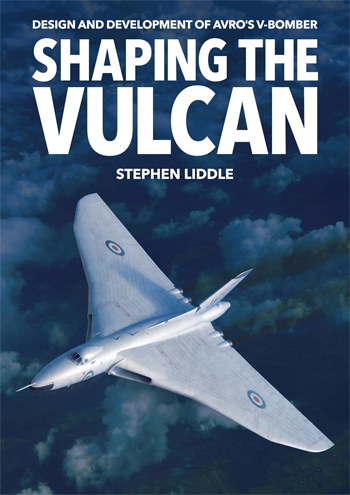
Coming soon from Tempest and author Stephen Liddle is Shaping the Vulcan, a full history of the Avro Vulcan’s development and assessment of the technological and engineering breakthroughs which underpinned the construction of this unparalleled aircraft.

The Avro Vulcan is one of the most striking aircraft ever made – its enormous wing stretching back from an improbably thick leading edge marked by cavernous wing root engine intakes. Perhaps even more incredible, its first flight was made just over ten years after the introduction of the piston-engined Lancaster during the Second World War. Within a decade, technology had taken a giant leap from straight-winged slow-moving conventional bombers to this vast delta designed to carry a nuclear payload. But what led to such a radical configuration and what was the technology that enabled such an ambitious design? What possessed Avro to offer the Air Ministry such a futuristic aircraft and what prompted the Ministry to approve its development and entry into service?

The 350 page hardcover book is currently available for pre-order with release set for May 14.

Product Page

Please Note: This post contains an Amazon affiliate link. When you purchase through links on our site, we may earn an affiliate commission.
Posted on

New Book Shows Iconic XB-70 Valkyrie In All Its Glory

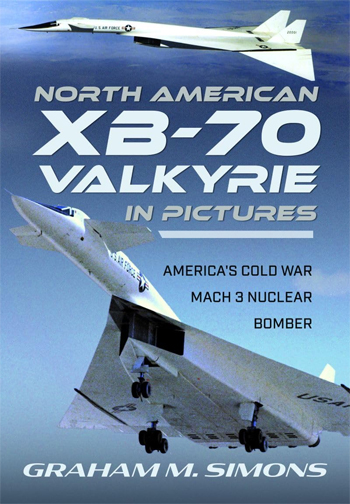
Coming soon from Air World and author Graham M Simons is North American XB-70 Valkyrie in Pictures: America’s Cold War Mach 3 Nuclear Bomber. The book explores the full story of the development of this legendary supersonic bomber using a unique collection of images. It also reveals the many challenges that the North American engineers faced, particularly with regards to engines and fuel, all of which are fully explained. In addition, it boasts first-hand testimony and analyses the accidents and incidents the aircraft were involved in, as well as a detailed timetable allowing the reader to comprehend the XB-70’s protracted history.

Flying at 70,000 feet, carrying nuclear weapons at Mach 3+ for thousands of miles, the North American Aviation XB-70 Valkyrie was not merely going to redefine military aviation, but the very nature of warfare itself. The XB-70 flew so fast and so high it would only appear on radar screens for a fleeting moment, making it impossible for enemy controllers to direct their interceptors to the target before it flew out of range. When it was first designed in the 1950s, the enemy, meaning at the time the Soviet Union, had no aircraft that could match the XB-70’s capabilities, rendering it almost invulnerable. But, just as the US was developing its technologies, so too were the Soviets. The introduction of their first surface-to-air missiles led to the US adopting low-level missions to sneak under radar. This effectively neutralised the XB-70’s main characteristics and, ultimately, the programme, which had cost the United States a staggering $800 million, the equivalent to $8.4 billion in modern terms, was cancelled.

The 256 page, hardcover book is currently available for pre-order with release slated for June 30.

Product Page

Please Note: This post contains an Amazon affiliate link. When you purchase through links on our site, we may earn an affiliate commission.

Posted on

New Illustrated History Focuses on the Folland Gnat, Red Arrow and Cold War Fighter

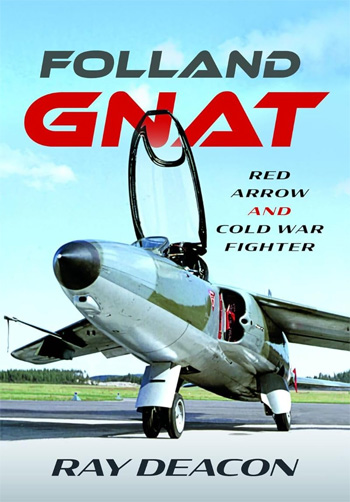
Coming soon from Pen & Sword and author Ray Deacon is Folland Gnat: Red Arrow and Cold War Fighter, an illustrated and factual record of the challenges faced by William Petter, chief designer at Folland Aircraft, in gaining recognition for his cheap, lightweight fighter concept.

Petter saw the Gnat as a viable alternative to other front-line interceptors, such as the Hunter and Swift, under development in the early 1950s. He called his fighter the Gnat, although ‘pocket rocket’ became a popular alternative. Unperturbed at having failed to attract interest from the RAF or Air Ministry, Petter decided to proceed with a privately-funded prototype powered by an Armstrong-Siddeley Viper engine to prove his design’s viability. Named Midge, the aircraft made its maiden flight at Boscombe Down in August 1954 and performed well. In July of the following year, the prototype Gnat made its maiden flight powered by a more powerful Bristol Orpheus engine. The Ministry of Supply finally began to offer support, placing an order for six development Gnats for trials work, but no production orders were forthcoming. Conversely, the Indian Government was very impressed, placing orders for a batch of Gnat fighters, followed by licenced-manufacture of several hundred examples in India. The Gnat went on to serve the country well in two wars with neighbouring Pakistan. Recalled in detail are the shooting-down of a number of Pakistani F-86 Sabres by the Gnat leading to the legendary sobriquet, ‘Sabre Slayer’. At the other end of the spectrum, Finland decided to expand its air force with the purchase of a squadron of Gnat fighters. Anticipating a requirement for a Vampire T.11 replacement, Petter wasted no time in preparing designs for a tandem-seat trainer based on the Gnat fighter, his efforts being rewarded with orders for a production variant for the RAF. There are also detailed accounts of the aircraft’s impressive period displaying with the famous Yellowjacks and Red Arrows aerobatic teams.

The 240 page, hardcover book is currently available for pre-order with release set for May 30.

Product Page

Please Note: This post contains an Amazon affiliate link. When you purchase through links on our site, we may earn an affiliate commission.
Posted on

Discover the Vital Role and Stunning Exploits of the F8U Crusader

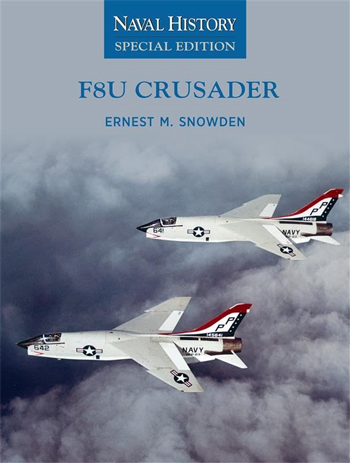
Newly released from Naval Institute Press and author Ernest M. Snowden is F8U Crusader: Naval History Special Edition, a richly illustrated volume exploring the F8U Crusader’s storied role in Cold War and Vietnam-era naval aviation, from setting speed records to earning its reputation as the “Last of the Gunfighters.”

From its first flight in 1955, the F8U Crusader proved to be an extraordinary aircraft, establishing a renowned fighter legacy for naval aviation. Building on its success with the F4U Corsair, aviator pioneer Chance Vought brought the Navy into the supersonic age with the Crusader, the first carrier-based fighter to exceed 1,000 mph in level flight. The Crusader earned the Navy its first Thompson Trophy for military aircraft speed and won the Collier Trophy for its innovative carrier suitability features. In 1957 future astronaut John Glenn set a new intercontinental speed record in an F8U-1P, flying from California to New York in just 3 hours and 23 minutes. At a time when guns were being replaced by missiles, Vought designers retained an integrated aircraft cannon, solidifying the Crusader’s reputation as the “Last of the Gunfighters” and earning the loyalty of its pilots.

The contribution of the Crusader to U.S. Cold War operations was substantial. The F8U-1P photoreconnaissance variant, the longest-serving Crusader model, debuted operationally during the Cuban Missile Crisis, providing irrefutable low-level imagery of Soviet activity. During the Vietnam War, Crusader pilots achieved an enviable 6-to-1 kill ratio, outperforming both Air Force and Navy F-4 Phantom pilots―a testament to the aircraft’s maneuverability and the dogfighting ethos of the Crusader’s pilot community.

The Crusader retired from U.S. Navy service in 1987, but its legacy endured as it continued to serve with the Philippine Air Force and the French Navy until 1999, forty-four years after its first flight. Author Ernest Snowden, a former naval aviator, provides an in-depth look at the design and operational history of this iconic aircraft, making this book a must-read for air combat history enthusiasts.

The publication spans 114 pages and is available in Mook format – a hybrid publication format blending elements of a magazine and a book.

Product Page

Please Note: This post contains an Amazon affiliate link. When you purchase through links on our site, we may earn an affiliate commission.
Posted on

Incoming: Examination of America’s Secret Cold War Fighters and Interceptors

Coming soon from Crecy Publishing Ltd and author Tony Buttler is American Secret Projects 5: Fighters and Interceptors 1950 to 1980. The new release is a revised and expanded edition of a book published some years ago which looks at American fighter projects that were proposed during the period.

This was an exciting era in terms of fighter development. It was during these years that the jet finally eclipsed the propeller, wings took on entirely new shapes, the ‘sound barrier’ was breached and maximum speeds were multiplied. It was an era in which aeronautical engineering became much more complex but before the computer would come to the designer’s assistance. This meant much more of a ‘try it and see’ attitude to new ideas. Therefore, when an air arm required a new fighter, several design teams could prepare proposals that could be very different from one another.

The topics discussed in detail in the book’s seven chapters include the quest for a long-range interceptor, vertical takeoff aircraft, naval developments and lightweight fighters. Appendices provide listings of all projects that were developed and their specifications. A new separate appendix looks at the Canadian Avro CF-105 Arrow which in many ways matched the work undertaken in the US on long-range interceptors and thus makes an interesting comparison.

The timeframe is fluid as some early projects included originated in the late 1940s. At the other end of the scale, although the design competitions which led to the F-16, YF-17 and F-18 are the final subjects covered in depth, a few projects that followed these fighters are included which again makes the 1980 closing date only approximate. No coverage is given to projects from that point onwards because much of the background is still secret and will probably remain so for a long time.

The 392 page hardcover book is currently available for pre-order with a February 19 release.

Product Page

Please Note: This post contains an Amazon affiliate link. When you purchase through links on our site, we may earn an affiliate commission.