Posted on

Discover the Vital Role and Stunning Exploits of the F8U Crusader

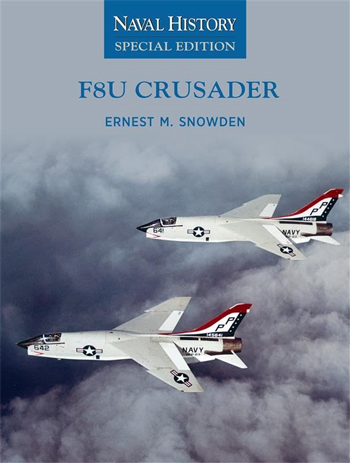
Newly released from Naval Institute Press and author Ernest M. Snowden is F8U Crusader: Naval History Special Edition, a richly illustrated volume exploring the F8U Crusader’s storied role in Cold War and Vietnam-era naval aviation, from setting speed records to earning its reputation as the “Last of the Gunfighters.”

From its first flight in 1955, the F8U Crusader proved to be an extraordinary aircraft, establishing a renowned fighter legacy for naval aviation. Building on its success with the F4U Corsair, aviator pioneer Chance Vought brought the Navy into the supersonic age with the Crusader, the first carrier-based fighter to exceed 1,000 mph in level flight. The Crusader earned the Navy its first Thompson Trophy for military aircraft speed and won the Collier Trophy for its innovative carrier suitability features. In 1957 future astronaut John Glenn set a new intercontinental speed record in an F8U-1P, flying from California to New York in just 3 hours and 23 minutes. At a time when guns were being replaced by missiles, Vought designers retained an integrated aircraft cannon, solidifying the Crusader’s reputation as the “Last of the Gunfighters” and earning the loyalty of its pilots.

The contribution of the Crusader to U.S. Cold War operations was substantial. The F8U-1P photoreconnaissance variant, the longest-serving Crusader model, debuted operationally during the Cuban Missile Crisis, providing irrefutable low-level imagery of Soviet activity. During the Vietnam War, Crusader pilots achieved an enviable 6-to-1 kill ratio, outperforming both Air Force and Navy F-4 Phantom pilots―a testament to the aircraft’s maneuverability and the dogfighting ethos of the Crusader’s pilot community.

The Crusader retired from U.S. Navy service in 1987, but its legacy endured as it continued to serve with the Philippine Air Force and the French Navy until 1999, forty-four years after its first flight. Author Ernest Snowden, a former naval aviator, provides an in-depth look at the design and operational history of this iconic aircraft, making this book a must-read for air combat history enthusiasts.

The publication spans 114 pages and is available in Mook format – a hybrid publication format blending elements of a magazine and a book.

Product Page

Please Note: This post contains an Amazon affiliate link. When you purchase through links on our site, we may earn an affiliate commission.
Posted on

From Sopwith Camel to Harrier: Hawker’s Naval Fighters Chronicled in New Book

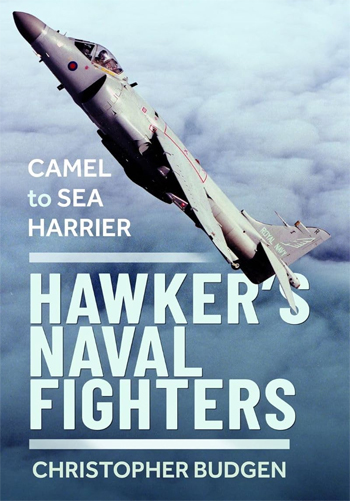
The naval fighters of Sopwith and Hawker will take center stage in author Christopher Budgen’s upcoming book Hawker’s Naval Fighters: Camel to Sea Harrier, released by Pen & Sword.

In 1912, TOM Sopwith transitioned from running a flying school to manufacturing aircraft, leveraging his nautical interests to create designs purchased by Britain’s Royal Navy. The onset of the First World War solidified the Sopwith Aviation Company’s reputation with aircraft like the Sopwith Camel widely used onboard the ships of the day. After the war, cancellations of government orders forced Sopwith Aviation into liquidation, However, a new company, the HG Hawker Engineering Company, was quickly formed, having been named after Sopwith’s test pilot, Harry Hawker. Throughout the 1920s and 1930s, Hawker produced designs that continued to be purchased by the Royal Navy, being used on the early aircraft carriers as well as the larger vessels of the fleet. With the outbreak of the Second World War, the RN’s Fleet Air Arm found itself woefully unprepared for battle, having mainly biplanes and slow monoplanes with which to face the modern German fighters and bombers. As a temporary solution, Hawker adapted the Hurricane into the Sea Hurricane. Hawker later developed advanced piston-engine fighters like the Fury and its naval counterpart, the Sea Fury, which saw action during the Korean War and Suez Crisis in 1956. The Sea Fury was succeeded by Hawker’s first jet, the Sea Hawk, marking the Fleet Air Arm’s transition into the jet age. The Sea Hawk also served the Indian Navy during its conflicts with Pakistan. Hawker’s successful Hunter, although primarily for the RAF, was used by the Royal Navy for land-based operations. Meanwhile, Hawker’s next design, the ground breaking Harrier, was ordered as the Sea Harrier; it saw action during the Falklands War, and, in due course, in the conflict in the former Yugoslavia and in Iraq. From its earliest days then, the Hawker Aircraft Company has supplied winning designs to the Royal Navy and to many navies overseas, a feat that few other companies could match.

The 232 Page hardcover book is currently available for pre-order with release scheduled for April 30.

Product Page

Please Note: This post contains an Amazon affiliate link. When you purchase through links on our site, we may earn an affiliate commission.
Posted on

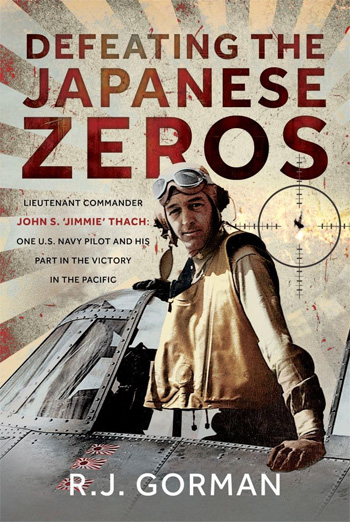
Defeating the Zero: How a Tactical Innovation Overcame Japan’s Deadly Fighter

Coming soon from Air World and author R J Gorman is Defeating the Japanese Zeros: Lieutenant Commander John S. ‘Jimmie’ Thach: One U.S. Navy Pilot and his Part in the Victory in the Pacific , detailing how a brilliant U.S. aerial tactic overcame Japan’s deadly Zero fighter, turning Midway into a decisive Pacific victory.

Lieutenant Commander John S. “Jimmie” Thach of the U.S. Navy recognized the threat posed by the Zero and devised a tactic to counter it. With the Japanese preparing to attack Midway Atoll, Thach trained his pilots in the “Thach Weave,” a revolutionary formation designed to offset the Zero’s superior performance. This tactic proved highly effective in air combat and allowed Thach’s squadron to neutralize the Japanese advantage. The battle at Midway became a turning point in the Pacific War. The U.S. Navy’s victory, aided by Thach’s tactical innovation, crippled Japan’s offensive capabilities. After Midway, the Japanese would never win another major battle, while the Americans would never lose one, marking a decisive shift in the war’s outcome.

The 240 page, hardcover book is currently available for pre-order with release slated for January 30.

Product Page

Please Note: This post contains an Amazon affiliate link. When you purchase through links on our site, we may earn an affiliate commission.

Posted on

Fighting Falcons: New WWII Pacific Air War History Landing Soon

Coming soon from Naval Institute Press and author Peter F. Owen is Fighting Falcons: The Campaigns of VMF-221 in the Pacific . The book “offers a compelling account of Marine Fighting Squadron 221 (VMF-221), a unit that played a key role in the Pacific during World War II.”

Author Peter F. Owen examines the operational realities behind the squadron’s missions, analyzing the Marine Corps’ performance in the Pacific air war. He explores how missteps at higher levels of command shaped outcomes in the air, and he sheds light on the complex logistics and maintenance challenges crucial to success. Based on extensive research, Fighting Falcons provides new insight into how Marine aviation functioned at the squadron level. The book delivers a valuable perspective on one of the Marine Corps’ notable fighter squadrons and the larger story of how the United States fought—and learned—its way to victory in the Pacific.

The 304 page book is currently available for pre-order in hardcover and Kindle editions with release slated for March 17.

Product Page

Please Note: This post contains an Amazon affiliate link. When you purchase through links on our site, we may earn an affiliate commission.
Posted on

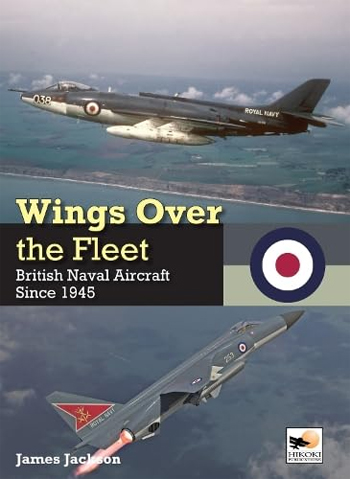
New Book Offers Comprehensive History of Royal Navy Carrier Aviation

Among the newest releases from Casemate / Hikoki is James Jackson’s Wings Over the Fleet: British Naval Aircraft since 1945, which is described as “a comprehensive history of Royal Navy carrier aviation from the 1940s to today, covering aircraft, helicopters, technology, and operations from Sea Hawks to F-35Bs.”

Wings Over the Fleet describes the evolution and development of the Royal Navy’s frontline aircraft from the late 1940s to the present day. All the major types are covered, from all-weather fighters, interceptors, strike aircraft, anti-submarine helicopters and airborne early warning aircraft. The planning and requirements behind the aircraft such as the Sea Hawk, Sea Vixen, Buccaneer, Gannet, Wasp, Sea King and Sea Harrier are examined, as are many design studies and proposals that remained on the drawing board. Guided missiles during the post-war period and the evolution of the Royal Navy’s aircraft carriers and the new technologies required to operate jet aircraft from ships are also analysed.

The hardcover book measures 8.74 x 1.3 x 11.97 inches and has 400 pages.

Product Page

Please Note: This post contains an Amazon affiliate link. When you purchase through links on our site, we may earn an affiliate commission.