
Posted on

Scanning the Skies: Radar Research and Development Flying 1935-1977

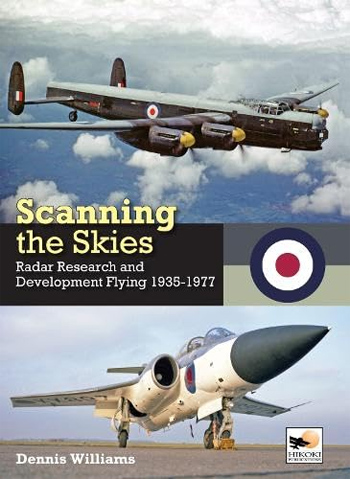
Coming soon from Crecy Publishing and author Dennis Williams is Scanning the Skies: Radar Research and Development Flying 1935-1977

This book offers a detailed overview of a complex yet fascinating aspect of British aviation history, about which comparatively little has been published. The early development of radar in Britain culminated in the successful introduction of ground-based radar, which played a crucial role during the Battle of Britain. This was followed by the considerable challenges of designing airborne systems that had to be compact, lightweight, and energy-efficient. The widespread use of radar and other electronic systems (including countermeasures) made a significant contribution to the major operations of RAF Coastal Command in the North Atlantic and Bomber Command over Europe; these aspects are covered in detail. During the Cold War, development priorities included navigation and guidance systems for the V-bombers and guided missile projects. Equally important as the scientific advances were the aircraft on which these technologies were tested. A large part of the book is devoted to the aircraft types used in British radar research and development over five decades, from the modifications required for this specialized task and the airfields used to operate them to the operational procedures. The development of aircraft, on the one hand, and the radar and other electronic systems tested on them, on the other, combine to form a coherent history of aviation in the service of scientific research. The account essentially follows a chronological sequence and illustrates how the rapid development of airframes and engines, as well as the advances in electronics and later in computer technology, went hand in hand throughout the entire period under consideration.

The hardcover book is currently available for pre-order with release set for October 31.

Product Page

Please Note: This post contains an Amazon affiliate link. When you purchase through links on our site, we may earn an affiliate commission.
Posted on

Wrecks & Relics 30th Edition: The Indispensable Guide to Britain’s Aviation Heritage

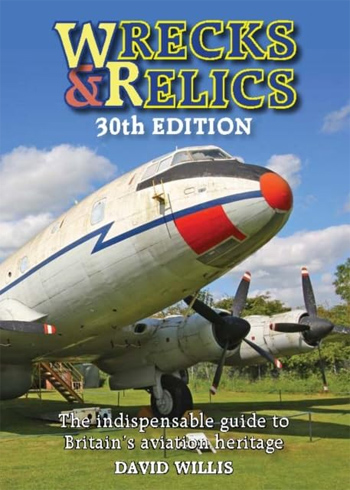
Coming soon from Crecy Publishing and author David Willis is Wrecks & Relics 30th Edition: The indispensable guide to Britain’s aviation heritage, A comprehensive, illustrated guide that chronicles more than 700 locations and 4,000 aircraft across the British Isles, detailing histories, current statuses, and where to explore preserving aviation heritage.

Wrecks & Relics remains the only publication required to discover the incredible aeronautical treasures found across the UK and Ireland. It provides a trusted, comprehensive rundown of museums and collections and their exhibits – static or flying – together with workshops, military ‘gate guardians’, stored and instructional airframes etc. It also reveals redundant and even derelict airframes being used for the most unlikely of purposes, including ‘glamping’ and at paint-ball sites.

Each edition of Wrecks & Relics is profusely illustrated with both colour and black and white photographs and is fully indexed making easy the task of where to go over the weekend, or where to find an extant example of a favourite aircraft type. Whether it travels in the car or sits on the bookshelf, this new and fully revised edition of this classic publication will continue to be the most useful and accurate companion to the aviation heritage of the British Isles, which will be referred to again and again.

The 392 page, hardcover book is currently available for pre-order with release set for August 26.

Product Page

Please Note: This post contains an Amazon affiliate link. When you purchase through links on our site, we may earn an affiliate commission.
Posted on

Operation Amherst: The Last Airborne Operation of WWII

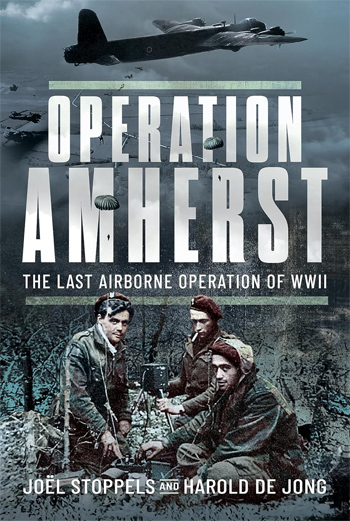
Coming soon from Pen and Sword Military and authors Joël Stoppels and Harold de Jong is Operation Amherst: The Last Airborne Operation of WWII, which covers the final airborne operation of WWII, detailing French paratroopers’ landings, rapid combat in Drenthe and Friesland, and subsequent liberation efforts in Groningen and beyond.

In preparation for the liberation of the northern part of the Netherlands, Operation Amherst was launched on the night of 7 to 8 April 1945. This last airborne operation of the Second World War was carried out by 702 French (SAS) paratroopers. The fighting developed quickly after the landings in the province of Drenthe and a part of southeast Friesland. Canadian and British forces would then engage in the liberation of Groningen and the Westerbork concentration camp, and the elimination of the Delfzijl Pocket.

The 224 page hardcover book is currently available for pre-order with release set for October 30.

Product Page

Please Note: This post contains an Amazon affiliate link. When you purchase through links on our site, we may earn an affiliate commission.
Posted on

Bird Men: The B-29 Superfortress and WW2 American Airpower

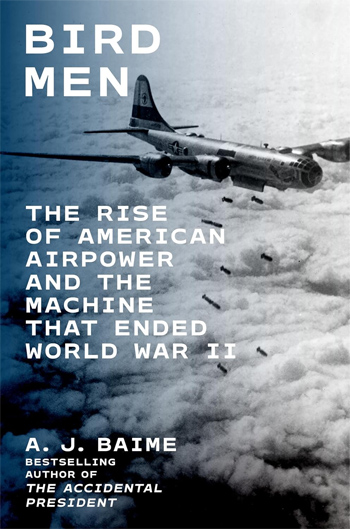
Coming soon from Mariner Books and bestselling author A.J. Baime is Bird Men: The Rise of American Airpower and the Machine That Ended World War II – A WWII History of American Airpower and the Superfortress That Changed the Course of the War.

Of all the feats of American ingenuity in World War II, perhaps none was as impressive in scale or vital to the Allied victory as the creation of American airpower. Just a few years before the start of World War II, the American military was stuck in the dark ages of aviation, with the U.S. Army’s Air Corps mainly focused, not on combat, but on mail delivery. Fast forward to end of the war, and America had launched the most impressive flying machine the world had ever seen: the B-29 Superfortress, a weapon so essential to ending the war that its research and development process cost more than the Manhattan Project. Continue reading Bird Men: The B-29 Superfortress and WW2 American Airpower

Please Note: This post contains an Amazon affiliate link. When you purchase through links on our site, we may earn an affiliate commission.
Posted on

Trace the Harrier’s Transformation From Prototype to Revolutionary Combat Aircraft

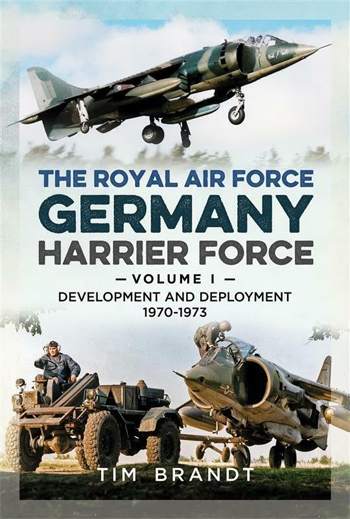
Coming soon from Fonthill Media and author Tim Brandt is The Royal Air Force Germany Harrier Force: Volume 1: Development and Deployment 1970-1973. This new account traces the Harrier aircraft’s transformation from prototype to complex war machine through the RAF Germany Harrier Force’s early years, detailing field operations, development, and the people who mastered vertical flight.

Royal Air Force Germany was the chief operator of the RAF’s Harriers during the Cold War. Its Harrier Force remains the only unit to have routinely taken large numbers of fast-jet aircraft into unprepared fields and woods, operating them in constant readiness for combat.

This book, the first of three volumes on the RAF Germany Harrier Force, describes how the aircraft was developed from a simple proof-of-concept prototype into a much more complex war machine, overcoming the extraordinary demands of vertical flight. It tells of the forming of the Harrier Wing at RAF Wildenrath in 1970, and how its people learned the hard way to fly and operate the ‘jump jet’ on base and in the field during those accident-laden early years. Volume I concludes at the end of 1973 when, having proven its capabilities, the Harrier Wing became the Harrier Force.

The 256 page, hardcover book is currently available for pre-order with release set for November 30.

Product Page

Please Note: This post contains an Amazon affiliate link. When you purchase through links on our site, we may earn an affiliate commission.
Posted on

Mastering The Cold War Jets: In-Depth Insights into Flying the Harrier, Jaguar, Phantom and Tornado

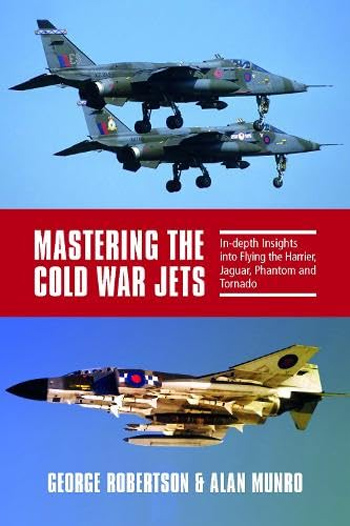
Coming soon from Grub Street Publishing and authors George Robertson and Alan Munnro is Mastering The Cold War Jets: In-Depth Insights into Flying the Harrier, Jaguar, Phantom and Tornado, which contains thought-provoking first-hand accounts that come from two friends who joined the RAF together on the same day in 1963, went through basic and advanced flying training together and then followed two parallel but different careers.

…As the book is written jointly, you get two different perspectives on the main RAF front-line roles in the Cold War. They describe going through the RAF pilot training system in the 1960s, the aircraft they flew, and the bases they operated from. After completing advanced flying training on the Folland Gnat at RAF Valley in Anglesey they followed different paths from then on. George went to the Canberra Conversion Unit (OCU) at RAF BAssingbounre and then to RAF Luqa in Malta to fly the Canberra PR9 in the reconnaissance role. Alan went to RAF Leuchars to convert on to the Gloster Javelin. Continue reading Mastering The Cold War Jets: In-Depth Insights into Flying the Harrier, Jaguar, Phantom and Tornado

Please Note: This post contains an Amazon affiliate link. When you purchase through links on our site, we may earn an affiliate commission.
Posted on

New Book Offers Comprehensive History of BAC Lightning With Many Previously Unpublished Photos

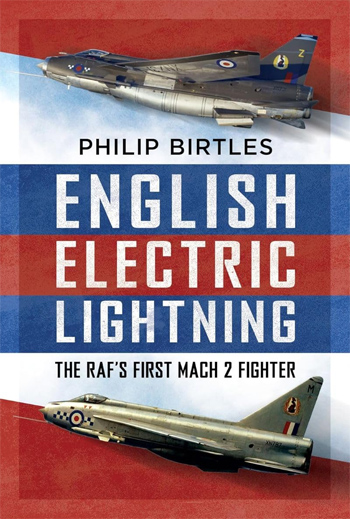
Coming soon from Fonthill Media and author Philip Birtles is English Electric Lightning: The RAF’s First Mach 2 Fighter, a comprehensive history and analysis covering the Lightning’s design, development and service with extensive illustrations, (many previously unpublished) as well as appendices detailing production, service, performance data, and information on preserved aircraft.

The English Electric Lightning was the first Mach 2 fighter to enter service with the RAF. It began life as a purely experimental design, and despite inadequate funding from the government, was developed by the manufacturer into a highly effective combat aircraft. It was also an export success, particularly with the Royal Saudi Air Force, paving the way for major export contracts of future aircraft with Saudi Arabia and other nations.

Lightnings were challenging to fly and maintain—one pilot famously likened it to ‘being saddled to a skyrocket’—but the aircraft was nonetheless revered by pilots and ground crew alike, who valued its astonishing rate of climb among other performance advantages. Among enthusiasts, it quickly became iconic.

The 240 page, hardcover book is currently available for pre-order with release set for October 30.

Product Page

Please Note: This post contains an Amazon affiliate link. When you purchase through links on our site, we may earn an affiliate commission.
Posted on

The Lightweight Mustangs: The Best Fighters of WW2

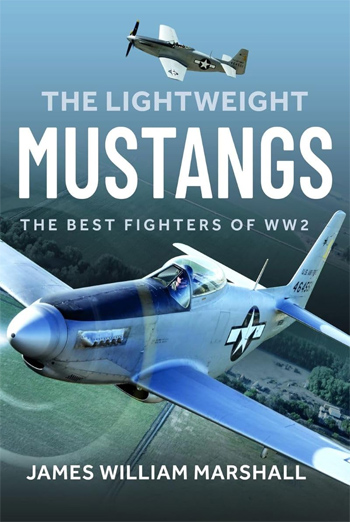
Coming soon from Pen & Sword and author James William Marshall is The Lightweight Mustangs: The Best Fighters of WW2.

Following America’s entry into the Second World War, the USAAF immediately began preparing itself for the battles ahead. One of its new requirements was for a fighter that could fly deep into Europe or over the vast distances of the Pacific. While this included extending the range of all of the USAAF’s tactical aircraft, particularly fighters, in what was called the Fighter Aircraft Range Extension Program, particular attention was given to the North American P-51 Mustang. The ground-breaking American program resulted in the design of the Lockheed P-38J and the North American P-51B, which were both intended to escort USAAF long-range bombers to any target they were tasked to attack. The pair was still in development when the USAAF undertook the infamous raids on the Bavarian city of Schweinfurt in August and October 1943. The only escort fighters available at that time were the shorter-range Republic P-47s Thunderbolts. Continue reading The Lightweight Mustangs: The Best Fighters of WW2

Please Note: This post contains an Amazon affiliate link. When you purchase through links on our site, we may earn an affiliate commission.
Posted on

New Official History Details RAF Decoys and Visual Deception of German Bombers in WW2

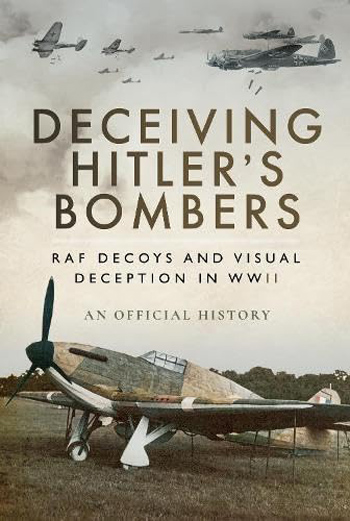
Coming soon from Air World is Deceiving Hitler’s Bombers: RAF Decoys and Visual Deception in WWII, which is an official history of clever visual deception―dummy sites, fake lights, and camouflage―to mislead German bombers and protect key locations during WW2.

The first, and most essential element in aerial bombardment is that of locating the target. All the inherent costs and risks in undertaking a bombing raid are of no avail unless the objective of the mission is correctly identified. If, through means of decoys or visual deception, the attacking aircraft can be tricked into dropping their deadly payloads in areas of little importance to the general war effort, the enemy bombers will have failed in their mission.

It was accepted at the start of the war that enemy bombers would always get through the UK’s defences and that the German bomber crews could be expected to have a reasonable understanding of Britain’s geography and of its main industrial and military facilities. That being the case, how could the most important sites be protected? Continue reading New Official History Details RAF Decoys and Visual Deception of German Bombers in WW2

Please Note: This post contains an Amazon affiliate link. When you purchase through links on our site, we may earn an affiliate commission.
Posted on

F-14 Tomcat’s Engineering and History Revealed in New “Visual Feast”

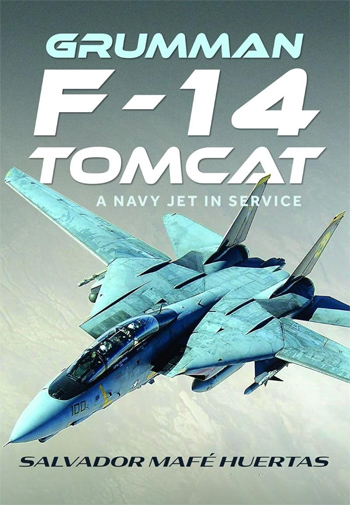
Coming soon from Pen & Sword and author Salvador Mafé Huertas is Grumman F-14 Tomcat: A Navy Jet in Service, a study of the aircraft that defined US naval air power through decades of combat, versatility, and enduring cultural iconography.

The Grumman F-14 Tomcat was a cornerstone of US Navy air power from the 1970s through to its retirement in 2006. Designed as a twin-engine, two-seat, supersonic interceptor, the F-14 was engineered to dominate the skies, primarily to counter Soviet aircraft during the Cold War.

The Tomcat’s sleek, angular design and distinctive variable-sweep wings gave it a menacing yet elegant silhouette, embodying both agility and raw power. Capable of adjusting its wing angle mid-flight – sweeping back for high-speed dashes or forward for enhanced manoeuvrability – the Tomcat adapted seamlessly to diverse combat scenarios, achieving speeds exceeding Mach 2.3 and a range of approximately 1,600 nautical miles.

As would be expected with an aircraft that remained in service for a number of decades, the F-14 had an impressive operational career. The type saw combat during the end of the Vietnam War, and was involved in the Lebanon Crisis in the early 1980s, Operation Desert Storm in the Gulf War, the Balkans Conflicts of the 1990s, flew strike missions during Operation Desert Fox (1998) and Operation Iraqi Freedom (2003). and even flew over Afghanistan during Operation Enduring Freedom in the early 2000s. It was in these conflicts that the Tomcat proved its mettle in reconnaissance, air superiority, and later, precision strike roles with the addition of the LANTIRN targeting system.

Beyond its technical prowess, the F-14 gained cultural fame through its starring role in the 1986 movie blockbuster Top Gun, and its subsequent sequel, cementing its image as a symbol of American military might and pilot bravado.

Though retired by the US Navy in favour of the F/A-18 Hornet, the F-14 remains operational in limited numbers with Iran’s air force – a fact which is given due attention in this study. The Tomcat’s legacy endures as a marvel of engineering and a cultural touchstone of aviation history all of which is revealed in this visual feast.

The page book is currently available for pre-order with release set for November 30.

Product Page

Please Note: This post contains an Amazon affiliate link. When you purchase through links on our site, we may earn an affiliate commission.