Posted on

The Observer Corps: The Hidden Defenders Tracking Enemy Aircraft in Britain’s Skies

Soon to be released by Helion and Company and author Kevin Wright is Skywatch Volume 1: A History of the Royal Observer Corps, 1925 to 1939.

During World War One, London was vulnerable to air attacks by Zeppelins and later German bombers. To defend the capital, the London Air Defence Area was created to coordinate the efforts to protect it. However, after 1918, the system was quickly abandoned.

In the early 1920s, the Committee for Imperial Defence began to reconsider the problem. In 1924, the first experiment was conducted to monitor and report the movement of aircraft overland by using small groups of aircraft observers reporting to a central point. This successful experiment led to the creation of the Observer Corps in 1925 under the control of Police Chief Constables.

Originally intended to cover just the South East of England to protect London, as the threat from resurgent Nazi Germany grew, the Corps was gradually expanded to cover nearly the whole of Gt Britain by the start of the War. Now transferred to the control of the Air Ministry, Observer Corps Groups became a key part of Fighter Commands integrated air defence system, unique in that it was the only means to track the movement of aircraft once they crossed the coast and headed inland.

Using a combination of new research and access to official files, Volume One of Skywatch charts the development of the Observer Corps from its origins, the very beginnings, formation and growth through the 1920s. It critically examines how, in the rush to prepare for War in the late 1930s, the Observer Corps began to ready itself for War and its unique role, monitoring the skies of Britain.

The 76 page publication is currently available for pre-order in paperback format. Release is slated for April 30.

Product Page

Please Note: This post contains an Amazon affiliate link. When you purchase through links on our site, we may earn an affiliate commission.
Posted on

The SPAD A Series: Its Technical Development and Combat Use

New from author Jack Herris and Aeronaut Books is The Spad A Series:

Spad is famous as the manufacturer of the Spad 13, the best Allied fighter of the Great War. However, Spad started the war with a much less successful aircraft, the Spad A, a two-seater of unusual configuration. This book describes its technical development and combat use. The story is told with 195 photos, color profiles of 18 aircraft, and scale drawings of two types.

The book spans 124 pages and is available in paperback edition.

Product Page

Please Note: This post contains an Amazon affiliate link. When you purchase through links on our site, we may earn an affiliate commission.

Posted on

Thomas-Morse Scout, Wright Brothers Take Center Stage in New Collections

Aerodynamic Media, LLC is proud to introduce two new additions to our recently launched series of Aircraft Collections.

The new offerings focus on the Thomas-Morse Scout WW1 advanced trainer and the Wright brothers / Wright aircraft. They compile nearly all related content that appeared in the original run of The Flying Machine journal from 2016-2023, and also include bonus content.

Click here to check out new releases, as well as our previous collections focused on the Sopwith Camel, Fokker Dr.1 and Curtiss Jenny.

Posted on

Finnish vs Russian Air Combat During the Winter War: An Illustrated Study

Coming this summer from Osprey and author Kari Stenman is Winter War 1939–40: Repelling the Soviets from Finnish skies, touted as the first illustrated study in English of the Finnish Air Force’s battle to repel the Soviet invaders during the Winter War, one of the greatest David-and-Goliath air battles in history.

In 1939, the Soviet Union invaded its neighbour Finland, sparking the Winter War. While Finland was heavily outnumbered in all respects, in few respects was the contest so uneven as in the air. In this book, veteran Finnish aviation historian Kari Stenman draws on his decades of research to present the first account in English of the Finnish Air Force’s defence of the country’s skies, a clash that pitted its 114 combat aircraft against the Soviets’ 2,318.

He explains that, equipped initially with a handful of British and Dutch aircraft, Finland’s air force adopted similar guerrilla tactics to its infantry. Fokker D.XXI interceptors were scattered to remote landing grounds to ambush the Soviets and give an impression of strength, while the bombers were first used for long-range reconnaissance and harassment. Over the course of the war, the Finns received new Gladiators, Fiat G.50s and French MS.406s, until at the close of the war, all flying units were thrown in to repel the Russian invasion across the frozen Gulf of Finland.

Illustrated with previously unpublished photos, superb original artwork, 3D diagrams and maps, this reveals for the first time the full story of how Finnish aviators fought for their country’s independence.

The 96 page publication is currently available for pre-order in paperback and Kindle editions. Release is set for June 16.

Product Page

Please Note: This post contains an Amazon affiliate link. When you purchase through links on our site, we may earn an affiliate commission.

Posted on

Pacific Turning Point: Airpower in New Guinea 1943–44

Coming soon from Osprey and authors Mark Stille and John Rogers is New Guinea 1943–44: The Allies assume the offensive, a fully illustrated history of airpower in the decisive stage of the New Guinea campaign, when the Allies could finally go on the offensive to shatter Japanese forces.

In this book, the second of two on the New Guinea campaign, Pacific War scholars Mark Stille and John Rogers draw upon years of research and Japanese, American and Australian sources to explain how the New Guinea air war turned against the Japanese between June 1943 and 1944. The over-extended IJAAF gradually lost combat strength in the face of vastly improved Allied airpower, leaving the Japanese unable to contend. One prong of the Allies’ air offensive targeted Japanese shipping to isolate its forces, while the other supported the ground offensives and landings that smashed Japanese forces and left most of them isolated for the rest of the war.

Packed with artwork, maps, and archive photos, this book explains how the lessons learned and the forces built up during the harsh struggle for Papua in 1942–43 transformed the Allies’ airpower into a decisive element in MacArthur’s 1943–44 campaign.

The 96 page publication is currently available for pre-order in paperpack and Kindle editions. Release is set for August 25.

Product Page

Please Note: This post contains an Amazon affiliate link. When you purchase through links on our site, we may earn an affiliate commission.
Posted on

Latest Collection from Renowned Artist Ronny Bar Focuses on WW1 British Fighters

Aviation artist Ronny Bar’s latest collection of aircraft profiles will soon be released by Tempest. The new collection British Fighters of the Great War is a visual and historical celebration of Britain’s single-seat fighter aircraft of the First World War.

Renowned aviation artist Ronny Bar presents a remarkable collection of meticulously researched colour profiles, capturing 15 of the most important British ‘scout’ fighters in vivid, authentic detail. Each aircraft is illustrated in a constant scale, with side, upper, and underside views that provide invaluable reference for historians, enthusiasts, and modellers alike.

From the iconic Sopwith Camel, Pup, Dolphin and Snipe – legendary products of the Sopwith Aviation Company – to other pivotal types such as the Bristol Scout, DH-2, DH-5, FE-8, and SE-5a, this volume traces the evolution of British fighter design from the tentative early days of aerial reconnaissance to the hard-won air superiority of the war’s later years.

Set against the backdrop of rapid technological change, tactical experimentation, and the courage of the pilots who flew these machines, the book combines striking artwork with a deep understanding of the historical context. Every profile is based on photographic evidence and thorough research, with informed interpretation used only where the passage of time has left gaps.

The 264 page book expands on the author’s previous collections of profiles as an authoritative color guide and a showcase of one of the genre’s finest artists, offering an unmatched visual reference to the aircraft that helped shape the air war over the Western Front. The book is currently available for pre-order with release set for May 31.

Product Page

Please Note: This post contains an Amazon affiliate link. When you purchase through links on our site, we may earn an affiliate commission.
Posted on

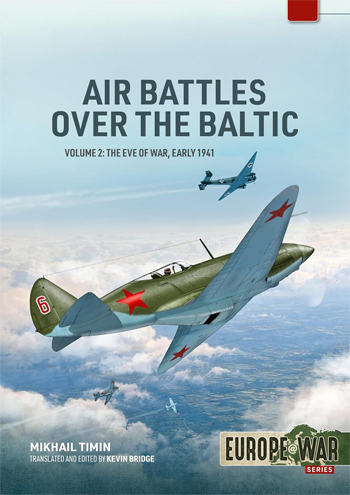
Major Four Part Study Opens With Examination of Soviet Air Power in the Baltic, 1940–41

Coming soon from Helion and Company and author Mikhail Timin is Air Battles over the Baltic 1941 Volume 1: Soviet Air Power in the Baltic 1940–41, the opening volume of a major four-part study that examines the Soviet Air Forces stationed in the Baltic region in the months before the German invasion of June 1941.

Using Soviet and German archival sources, acclaimed aviation historian Mikhail Timin provides the most detailed account yet of how these forces were organised, trained and equipped, and the extent to which they were prepared for the challenge to come… Richly supported by colour profiles, photographs, maps and tables, this volume offers a comprehensive analysis of the Baltic air alignment in 1940. It sets the essential foundation for understanding the disastrous air battles that followed on 22 June 1941, when the Luftwaffe struck and the Red Air Force struggled to respond.

The 104 page paperback publication is currently available for pre-order with release set for May 31.

Product Page

Please Note: This post contains an Amazon affiliate link. When you purchase through links on our site, we may earn an affiliate commission.

Posted on

Flying Colours: Historic Aircraft Color Profiles By Richard J. Caruana

Coming soon from MMPBooks and Richard J. Caruana is Flying Colours of Richard J. Caruana, which focuses on illustrations of historic aircraft produced over his 50 year career.

During the last decade or so a considerable number of requests were received, especially from the younger generation, for me to put together a cross-section of my work into a book. Truly an impossible task considering the thousands of illustrations produced over these fifty years. It was therefore with this in mind that I’m embarking on this voyage of memories that will hopefully be met with approval by both those who remember the drawings in now-defunct or difficult to find publications and also those too young to have had the opportunity of enjoying them. It also gave me the chance to update older illustrations to today’s standards.

This release will be the latest in a series of publications focusing on his aircraft profiles. It will include the Fokker D.VII, FIAT CR.32, Fleet Air Arm Corsairs, Boulton Paul Defiant, Last of the Spitfires, USAF Starblazers, SEPECAT Jaguar and Guido Pongiluppi.

The 48 page, paperback publication is currently available for pre-order with release set for March 15.

Product Page

Please Note: This post contains an Amazon affiliate link. When you purchase through links on our site, we may earn an affiliate commission.

Posted on

WW2 Rocket Interceptors Detailed With Immaculate Tech Drawings, Full Performance Specs

Coming soon from Fonthill Media and author Justo Miranda is Rocket Interceptors 1941–1947:

During its short life, the rocket interceptor, a concept that reached maturity towards the end of the Second World War, attracted the attention of top scientists, designers and aeronautical engineers in Germany, the USSR, the United States and Japan. It was universally agreed that an interceptor capable of flying 300 mph faster than any other aircraft would give the wielding power untouchable aerial superiority. However, this new technology was unable to adapt to the realities of war.

The complexity of the propulsion system and the need to develop new aerodynamic concepts were challenges too great for the aeronautical industries of the major powers at the time, which specialized in the mass construction of piston fighters. Nor were fighter pilots able to adapt to the high-G combat conditions that came with achieving speeds of nearly 900 mph; it was simply not possible for them to aim and fire.

In 280 immaculate technical drawings, each set within its historical context and with full performance specifications, Rocket Interceptors 1941–1947 presents 125 project, prototype and combat rocket-powered aircraft developed by Germany, the United States, the USSR and Japan in the 1940s, though initial development for some can be traced as far back as the 1920s. This is the last word on a technology that, had it been properly harnessed, might have changed the course of the Second World War.

The 288 page, hardcover book is currently available for pre-order with release set for May 30.

Product Page

Please Note: This post contains an Amazon affiliate link. When you purchase through links on our site, we may earn an affiliate commission.
Posted on

After the Bombs: The Doolittle Raiders’ Suspenseful, Moving Fight to Survive

Soon to be released from Air World is The Doolittle Raiders’ Battle for Survival: The Men Who Bombed Tokyo and their Harrowing Story of Escape and Capture in China. This is author Geert Rottiers’ extraordinary account of courage, survival, and sacrifice in the aftermath of one of the Second World War’s most daring missions. While the Doolittle Raid on Japan is often celebrated for its audacity and strategic importance, this book focuses on the tortuous journey of the Raiders once their mission was complete, as they descended – quite literally – into the unknown.

After striking targets in Japan on 18 April 1942, the Raiders, flying their North American B-25 bombers, faced an impossible challenge: reaching safety with dwindling fuel reserves. While one crew landed in the Soviet Union, the remaining fifteen crash-landed or baled out over Japanese-occupied China, initiating a desperate struggle for survival. Spread across rugged terrain, the Raiders battled severe weather, injuries, starvation, and the constant threat of capture or death at the hand of the Japanese forces.

This book delves deeply into the human stories of the Doolittle Raiders during their escape through hostile territory. It highlights the critical role played by Chinese villagers and resistance fighters who risked – and often lost – their lives to protect the stranded Americans. Through their heroic efforts, many Raiders made it to safety, but not without significant losses. The Japanese retaliated mercilessly against the Chinese in one of the largest manhunts the Japanese ever mounted, killing tens of thousands in the Zhejiang-Jiangxi Campaign, underscoring the devastating costs of the mission.

With its rich blend of action, human drama, and historical depth, and drawing on declassified military records, personal diaries, and interviews with descendants of the Raiders and their Chinese allies, The Doolittle Raiders’ Battle of Survival vividly reconstructs the Raiders’ perilous journey to safety – or not. From parachute landings into dense forests and dangerous mountain crossings to encounters with guerrilla fighters and near-capture by Japanese troops, the narrative is both suspenseful and deeply moving.

The 256 page hardcover book is currently available for pre-order with release slated for May 30.

Product Page

Please Note: This post contains an Amazon affiliate link. When you purchase through links on our site, we may earn an affiliate commission.