Posted on

MiniArt to Release Junkers F13 Mid-Production Model Kit

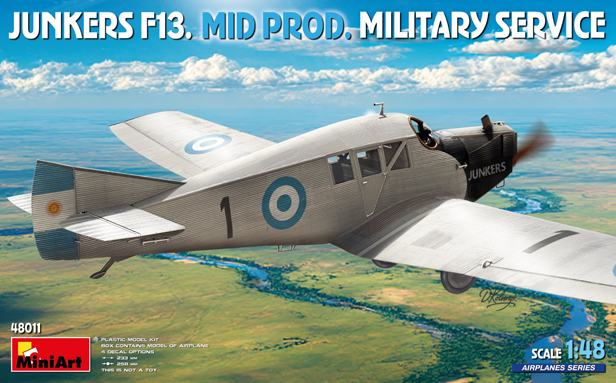
MiniArt has announced the upcoming release of a new Junkers F13 mid-production variant in 1/48 scale.

The release (48011) represents the mid-production version of the Junkers F13 adapted for military service. As one of the world’s first all-metal transport aircraft, the F13 served in both civil and military roles, proving its reliability and versatility in various conditions.

The model features the characteristic corrugated metal surfaces and captures the unique design of this pioneering aircraft. It includes a detailed cockpit and surface structure as well as marking options for four aircraft.

As of this writing the model is listed as “coming soon,” although a final release date has not yet been announced. Click below to check out livery profiles and kit contents.

Continue reading MiniArt to Release Junkers F13 Mid-Production Model Kit

Posted on

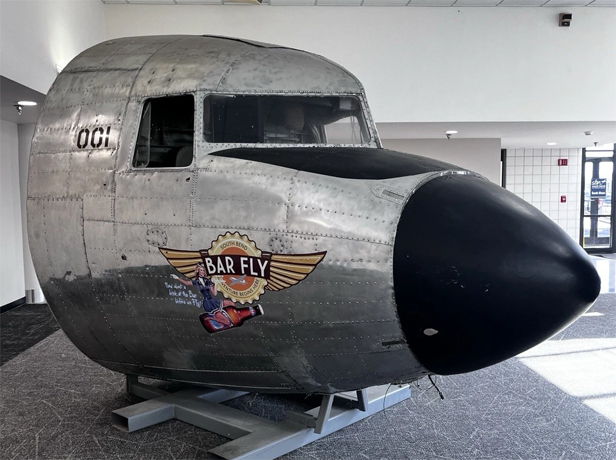
DC-3 Nose / Cockpit Section For Sale: “Has Been Restored”

A DC-3 nose / cockpit section has been spotted for sale. The listing states (in part):

Original vintage DC-3 airplane nose cone with classic streamlined aircraft design and authentic aviation character. A rare and eye-catching collectible, ideal for display, restoration projects, or aviation memorabilia collections. Has been restored.

The section is located in South Bend, Indiana. Click here to check out the eBay listing, which includes additional photos and details.

Please Note: This post contains an eBay affiliate link. When you purchase through links on our site, we may earn an affiliate commission.

Posted on

The History of British Airways Told Through Museum Artifacts

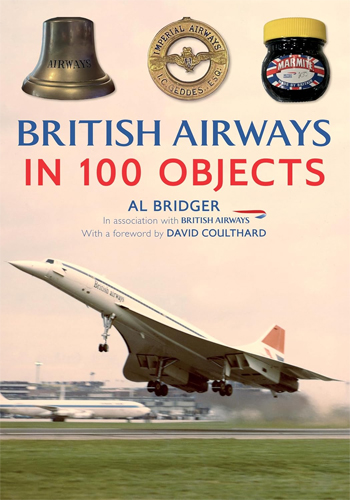
Coming soon from Amberley Publishing and author Al Bridger is British Airways in 100 Objects, which is focused on artifacts held by the British Airways Speedbird Centre.

British Airways has an almost unique history. Spanning over a century from the first flight of Aircraft Transport and Travel Ltd from London to Paris in 1919 to the modern fuel-efficient aircraft of its current fleet, British Airways has proudly connected Britain to the World and the World to Britain. Over that journey through the rapidly evolving early years of pioneering aviation, taking days to cross continents with biplanes and seaplanes, through the post-war piston-engine luxury, the iconic jet age of the fabulous Boeing 707 and 747, the supersonic marvel of Concorde into the modern era of travel, British Airways has seen many historic events and carried literally billions of customers. Along the way that journey has generated vast amounts of treasured items, many of which are now displayed or stored at British Airways headquarters near Heathrow in its truly incredible museum, the Speedbird Centre. Much of the archive has true national importance and is kept as part of the nation’s heritage. From simple in-flight mementos to the Olympic torch, the items featured in this book represent just a flavour of that collection and bring decades of flight to life.

The 144 page, paperback publication is currently available for pre-order with release set for May 15.

Product Page

Please Note: This post contains an Amazon affiliate link. When you purchase through links on our site, we may earn an affiliate commission.

Posted on

The Observer Corps: The Hidden Defenders Tracking Enemy Aircraft in Britain’s Skies

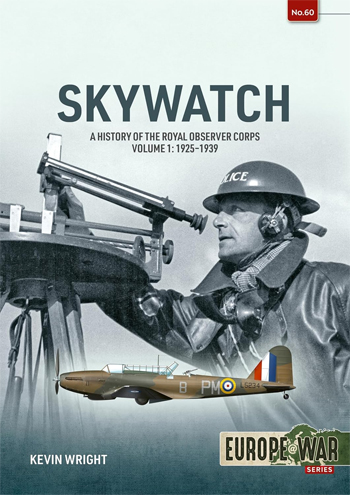
Soon to be released by Helion and Company and author Kevin Wright is Skywatch Volume 1: A History of the Royal Observer Corps, 1925 to 1939.

During World War One, London was vulnerable to air attacks by Zeppelins and later German bombers. To defend the capital, the London Air Defence Area was created to coordinate the efforts to protect it. However, after 1918, the system was quickly abandoned.

In the early 1920s, the Committee for Imperial Defence began to reconsider the problem. In 1924, the first experiment was conducted to monitor and report the movement of aircraft overland by using small groups of aircraft observers reporting to a central point. This successful experiment led to the creation of the Observer Corps in 1925 under the control of Police Chief Constables.

Originally intended to cover just the South East of England to protect London, as the threat from resurgent Nazi Germany grew, the Corps was gradually expanded to cover nearly the whole of Gt Britain by the start of the War. Now transferred to the control of the Air Ministry, Observer Corps Groups became a key part of Fighter Commands integrated air defence system, unique in that it was the only means to track the movement of aircraft once they crossed the coast and headed inland.

Using a combination of new research and access to official files, Volume One of Skywatch charts the development of the Observer Corps from its origins, the very beginnings, formation and growth through the 1920s. It critically examines how, in the rush to prepare for War in the late 1930s, the Observer Corps began to ready itself for War and its unique role, monitoring the skies of Britain.

The 76 page publication is currently available for pre-order in paperback format. Release is slated for April 30.

Product Page

Please Note: This post contains an Amazon affiliate link. When you purchase through links on our site, we may earn an affiliate commission.
Posted on

LEGO to Release Large Pan-Am DC-3 Model With Impressive Details

LEGO is preparing to release a new Douglas DC-3 building set in Pan-Am colors.

The new set (#11378) includes four minifigures (pilot, purser, stewardess and flight attendant) wearing historical Pan-Am uniforms, a detailed cockpit and passenger cabin, retractable landing gear, as well as a model display stand with an information plaque and a Pan Am-branded minifigure display stand. Fuselage sections can be removed to view interior details.

The model consists of 1,903 pieces and measures 9.5 in. (24 cm) high, 20 in. (51 cm) long, and 30 in. (76 cm) wide (including stand). It is currently slated for release in early April. Click below to check out additional images.

Continue reading LEGO to Release Large Pan-Am DC-3 Model With Impressive Details

Posted on

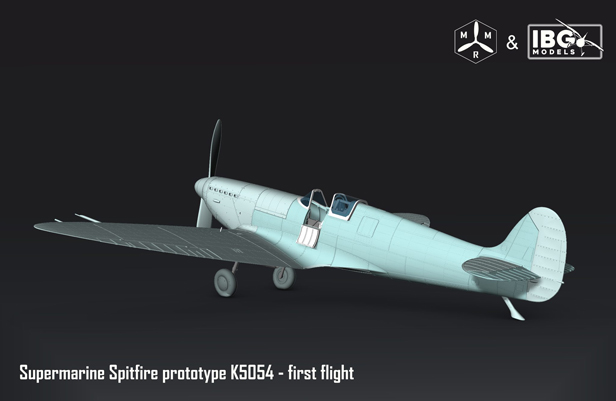
New IBG Kit Recreates Spitfire Prototype’s Full History For Type’s 90th Anniversary

To celebrate the Spitfire’s 90th anniversary, IBG Models has collaborated with MRM Studio to create a new limited edition model.

The body of the model is based on the IBG plastic kit, but in practice this means a completely new design. Each element has been re-designed to faithfully reflect all the differences between the early prototype and the later production machines. In order to show the evolution of this design as accurately as possible, we have prepared four variants of the aircraft’s nose, two types of fuselage, and two variants of wings – both in the original unarmed configuration and the later armed configuration used during testing. This allows modelers to reproduce the different stages of the machine’s development.

The 1/72 kit employs high-quality 3D printing technology and a vacu-type cockpit canopy with an innovative snap-vac system that uses printed frames that are applied to the transparent part without the need for traditional masking during painting. Additional features include a 3D-printed test pilot figure, Techmod decals and mask designs for painted markings.

The entire edition includes two different sets, which together allow you to recreate the full history of this unique aircraft – from its first flight to its crash on the second day of the war.

The first set (A72001), which depicts the aircraft in its configuration in the first test flight, will be limited to 400 pieces and is slated for release in April. Click below to check out additional images.

Continue reading New IBG Kit Recreates Spitfire Prototype’s Full History For Type’s 90th Anniversary

Posted on

Skyhookers: An Illustrated History of Parasite Fighters

New from Air World and author William Wolf is Skyhookers: An Illustrated History of Hook-on Aircraft and Their Dirigible Motherships.

From the First World War’s Zeppelins to the Second World War’s large bombers, military aircraft were vulnerable to fast, manoeuvrable interceptors. To address this, fighter escorts were used, but their limited range often left bombers exposed. A solution was the use of Composite aircraft, where larger bombers carried smaller, short-range fighters, which could be launched and retrieved as needed.

Zeppelins, particularly vulnerable to interceptors, were ideal for this concept. During the First World War, Germany briefly experimented with carrying parasite aircraft, while the British conducted post-war trials using airships like His Majesty’s Airship R-23 and R-33, carrying fighters such as the Sopwith Camel and de Havilland DH.53 Humming Bird. However, successful hook-on/retrievals were only achieved with the Humming Bird.

The US Navy and Army further developed this concept. In 1918, the Navy launched a Curtiss JN ‘Jenny’ from a C-1 Blimp, and in 1924, the Army successfully flew a Sperry Messenger from a TC-Class airship. The US perfected the carry/launch/retrieval method for airship defence and scouting, notably with the USS Los Angeles, which carried aircraft on a ‘trapeze’ device. The Akron and Macon airships, with internal storage for aircraft, further advanced this technique, making them some of the most remarkable aircraft of their time.

The 200 page book is currently available in hardcover and Kindle editions.

Product Page

Please Note: This post contains an Amazon affiliate link. When you purchase through links on our site, we may earn an affiliate commission.
Posted on

Now Available: E-Flite’s New Ultra Micro Gee Bee R-2 RC Model

E-Flite has released their new ultra micro Gee Bee R-2 510mm BNF Basic RC model with AS3X and SAFE Select.

The E-flite UMX Gee Bee R-2 is ready to soar through the skies in more places and smaller spaces thanks to its handling that has more in common with a friendly sport model than a short-coupled golden age racer. Awe-inspiring with an authentic scale outline and abundant details such as flying wires plus a pilot, this replica offers handling so remarkably smooth, you’ll want to fly it every day. AS3X® technology works behind the scenes to help you enjoy the outstanding stability and control you always wanted but never thought possible in such a small airplane, let alone in a model of the Gee Bee. Optional-use SAFE® Select flight envelope protection technology delivers automatic self-leveling plus pitch and bank angle limits that make it possible to successfully fly such a unique design even if you’re an intermediate RC pilot. It also features a quieter and more powerful 2S and 3S compatible motor, along with a modified fuselage and stronger wing, designed to handle the extra weight, power, and speed when using 3S 280–300mAh batteries. Best of all, it arrives 100% factory-assembled and ready to bind to your favorite Spektrum™ DSM2/DSMX®-equipped transmitter so you can be flying in almost no time! And it all adds up to deliver a model of the classic Gee Bee that’s a dream to fly while offering an exciting and incredibly unique flight experience from large yards and small parks to sports fields and beyond!

As previously reported, the new model (EFLU61500) follows E-Flite’s recent release of a larger 1.0m Gee Bee R-2.

Buy on eBay

Please Note: This post contains an eBay affiliate link. When you purchase through links on our site, we may earn an affiliate commission.
Posted on

RAF’s Interwar Activities Chronicled With Hundreds of Rare Photos

Coming soon from Jonathan Falconer and JJN Publishing is The RAF Between The Wars 1918-39 (The Photographic Archive): Policing The Empire

The book is a visual history chronicling the Royal Air Force’s imperial policing operations from 1918 to 1939 across British territories like Iraq, Palestine, Aden, and India. Featuring hundreds of rare archival photographs of aircraft such as the Vickers Vernon and Airco DH.9A, personnel, and campaigns against tribal unrest, it highlights the RAF’s evolution into a key imperial tool through tactics like air control for low-intensity policing amid post-WWI budget constraints.

The 144 page, hardcover book is currently available for pre-order with release scheduled for March 6.

Product Page

Please Note: This post contains an Amazon affiliate link. When you purchase through links on our site, we may earn an affiliate commission.
Posted on

ICM Releases New Luftwaffe Pilot School Kit With Detailed Hs 123A Biplane

ICM has released a new Luftwaffe Pilot School model kit in 1/32 scale.

The Henschel Hs 123A served as a dive bomber and close‑support aircraft in addition to training duties. It featured all‑metal sesquiplane construction and was powered by a BMW 132 radial engine. The aircraft was armed with two 7.92 mm machine guns and around 450 kg of bombs, typically a 250 kg centerline bomb and smaller wing bombs. Entering service in the mid‑1930s, it was rugged, highly maneuverable, and able to operate from rough front‑line airfields, which made it effective in the Spanish Civil War and early Second World War campaigns despite being technically obsolete. With a top speed of about 340 km/h and excellent dive‑bombing characteristics, the Hs 123A earned a reputation for toughness and reliable close air support, remaining in service longer than originally intended until withdrawn mainly due to spare‑parts shortages.

The new release (32017) consists of three Luftwaffe cadets and an Hs 123A training biplane. It includes detailed uniform elements, accurate geometry and proportions, a detailed cockpit and fuselage and step-by-step instructions.

Buy on eBay

Please Note: This post contains an eBay affiliate link. When you purchase through links on our site, we may earn an affiliate commission.