Posted on

Mosquito: The Ultimate Guide to the ‘Mossie’

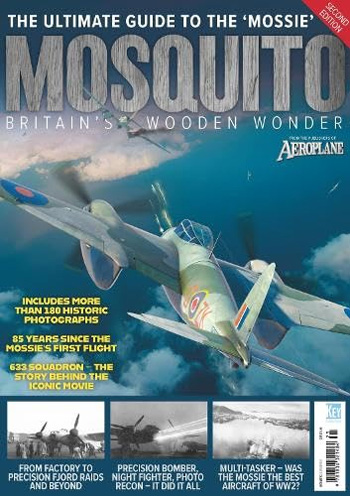
Coming soon from Key Publishing is Mosquito: The Ultimate Guide to the ‘Mossie.’

The de Havilland DH.98 Mosquito was one of the outstanding aircraft of World War Two, making a significant contribution to the Allied victory. Of mainly wooden construction, the ‘Mossie’ was one of the fastest operational aircraft in the world, and while designed as an unarmed high speed bomber, the ‘Wooden Wonder’ was quickly adapted as a night fighter, a fighter-bomber, and photo-reconnaissance aircraft. The Mosquito played a pivotal role in the bomber campaign, proving able to carry a 4,000lb bomb to Berlin, while giving its crew a much better chance of surviving the experience! It was also used for a succession of daring low level precision attacks against a range of targets, many of which are described in this amazingly researched 132-page special.

The publication is currently available for pre-order with release set for July 23.

Product Page

Please Note: This post contains an Amazon affiliate link. When you purchase through links on our site, we may earn an affiliate commission.
Posted on

Newly Restored Mosquito PZ474 Arrives At New Home [Video]

Texas-based Lewis Air Legends has reported the arrival of their newly restored de Havilland Mosquito PZ474, which is one of only four airworthy examples of the type in the world.

As previously reported, the Mosquito FB VI was originally constructed at Hatfield in 1945 and was used for RAF training before serving with 75 Squadron in New Zealand as NZ2384. In the 1950s and 60s the machine was owned by the Insurance Finance Corp. of Studio City, CA, and is believed to have been used by the CIA for intelligence gathering in South America. Continue reading Newly Restored Mosquito PZ474 Arrives At New Home [Video]

Posted on

Newly Restored Mosquito PZ474 Featured in New Video

Lewis Air Legends and Avspecs, Ltd. have shared a new feature on newly restored Mosquito FB VI PZ474 aired by Television New Zealand’s (TVNZ) Seven Sharp.

As previously reported, the machine was originally constructed at Hatfield in 1945 and used for RAF training before moving on to New Zealand in 1948, where it was overhauled and delivered to 75 Squadron as NZ2384. In the early 1950s, the aircraft was acquired by new owners and registered as ZK-BCV before being transferred to the United States. There, the Mosquito was given civil registration N9909F and, from around 1955-66, was owned by the Insurance Finance Corp. of Studio City, CA. During this time it was believed that the machine was used by the CIA for intelligence gathering in South America.

Continue reading Newly Restored Mosquito PZ474 Featured in New Video

Posted on

Mosquito PZ474 Performs First Post-Restoration Flight [Video]

Yesterday, Mosquito FB VI PZ474 performed its first post-restoration flight from Ardmore Airport in New Zealand.

As previously reported, the machine was originally constructed at Hatfield in 1945 and used for RAF training before moving on to New Zealand in 1948, where it was overhauled and delivered to 75 Squadron as NZ2384. In the early 1950s, the aircraft was acquired by new owners and registered as ZK-BCV before being transferred to the United States. There, the Mosquito was given civil registration N9909F and, from around 1955-66, was owned by the Insurance Finance Corp. of Studio City, CA. During this time it was believed that the machine was used by the CIA for intelligence gathering in South America. Continue reading Mosquito PZ474 Performs First Post-Restoration Flight [Video]

Posted on

Newly Restored Mosquito PZ474 Performs First Port Engine Test [Video]

On November 8, Avspecs, Ltd. rolled out Mosquito FB VI PZ474 for its first port engine test in Ardmore, New Zealand.

The machine was originally constructed at Hatfield in 1945 and used for RAF training before moving on to New Zealand in 1948, where it was overhauled and delivered to 75 Squadron as NZ2384. In the early 1950s, the aircraft was acquired by new owners and registered as ZK-BCV before being transferred to the United States. There, the Mosquito was given civil registration N9909F and, from around 1955-66, was owned by the Insurance Finance Corp. of Studio City, CA. During this time it was believed that the machine was used by the CIA for intelligence gathering in South America.

In 1970, PZ474 was abandoned and began a period of decline. It wouldn’t be saved until 2014, when it was acquired by Rod Lewis of Lewis Air Legends in San Antonio, Texas. Continue reading Newly Restored Mosquito PZ474 Performs First Port Engine Test [Video]

Posted on

De Havilliand Mosquito HJ711 Performs Successful Engine Test in Lincolnshire [Video]

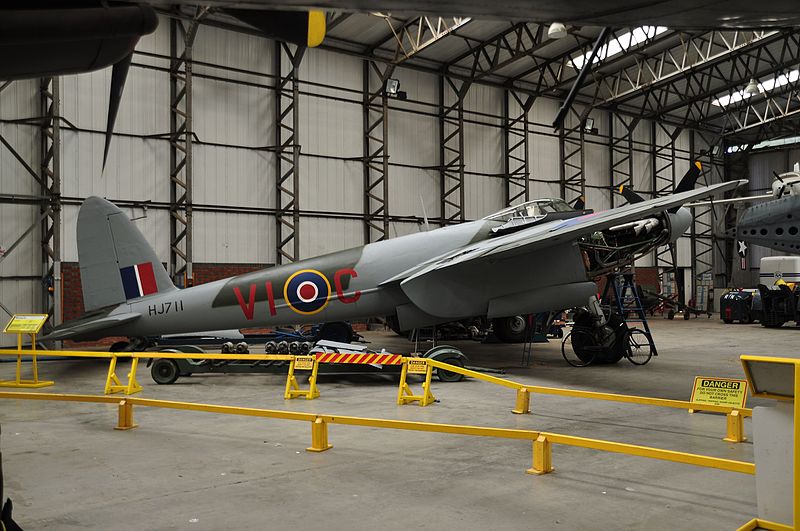
On September 19, Tony Agar’s de Havilland Mosquito NF.II HJ711 performed a successful run of its port engine at the Lincolnshire Aviation Heritage Centre.

As previously reported, the aircraft was built at Hatfield in 1943 and went on to serve with 141 and 169 Squadrons, scoring the latter’s first kill on January 30, 1944 when pilot Squadron Leader J.A.H. Cooper downed a Bf 110 over Berlin. Following the war, HJ711’s forward fuselage was transferred to RAF Air Training Command at Chingsford before the nose section resurfaced at the Reflectaire Museum in Blackpool. Agar acquired the remains in 1971 and began a long term restoration to taxiing condition using components of PF498, VA878, NT616, and RS715.

The machine spent many years at the Yorkshire Air Museum in Elvington, York before the decision was made to relocate it to Lincolnshire, which has additional facilities available to complete restoration work.

Click below to check out videos of Wednesday’s test.

Continue reading De Havilliand Mosquito HJ711 Performs Successful Engine Test in Lincolnshire [Video]

Posted on

New Engineering Plan Announced to Return DH Mosquito RL249 to UK Skies

1

Leicestershire-based charity The People’s Mosquito (TPM) has announced an “achievable, structured five-year engineering plan” to return de Havilland Mosquito RL249 to UK skies.

The news reportedly comes after close consultation with the historic aircraft experts at Retrotec, Ltd. and includes the launch of a dedicated fundraising campaign which seeks to raise “£499,000 over the next 12 months to deliver the successful front-end engineering, tooling and design and fabrication of the Mosquito FB.VI fuselage mould in the UK.”

The funding will reportedly support “crucial UK CAA due diligence from the outset of the project” and enable Retrotec’s engineers to analyze TPM’s massive technical library and develop exact computer aided design (CAD) models for the airframe. Additionally, the funding will allow Retrotec’s workshops to be reconfigured to accommodate the build and enable the fabrication the Mosquito’s unique fuselage mold, which will see the return of a manufacturing capability “not seen on these shores for more than 75 years.” Continue reading New Engineering Plan Announced to Return DH Mosquito RL249 to UK Skies