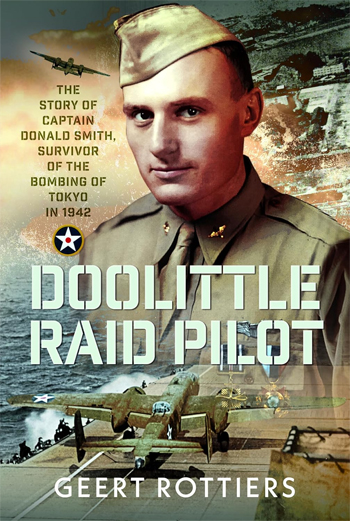
Set for release later this year from Pen & Sword and author Geert Rottiers is Doolittle Raid Pilot: The Story of Captain Donald Smith, Survivor of the Bombing of Tokyo in 1942.
Donald Gregory Smith’s early years were shaped by trauma. He was 5 years old when his mother died, following which he was placed in an orphanage by his father. Despite this background, in 1940, Donald earned a Bachelor of Science degree from the University of South Dakota. After graduation, he was commissioned as a second lieutenant in the infantry, but his passion led him to a career in aviation. By March 1941, through sheer determination and discipline Smith had completed his flight training and became a pilot in the Army Air Corps. In 1942, he was selected for a top-secret mission led by Lieutenant Colonel James H. Doolittle: a surprise bombing raid on Japan in retaliation for Pearl Harbor. The story follows Smith during his embarkation aboard the USS Hornet, alongside fifteen other B-25 Mitchell crews. During training, he successfully lifted off after only eighty-seven meters – the shortest take-off of all the Raiders. On 18 April 1942, the day of the infamous Doolittle Raid, Donald’s crew bombed industrial targets in Kobe with precision. During the subsequent diversionary flight to China, his aircraft was attacked by Japanese fighters, but Smith managed to evade them over the Sea of Japan. A shortage of fuel forced Smith to execute a perfect belly landing on water in the East China Sea before getting ashore. With the help of Chinese villagers, Smith and his crew evaded advancing Japanese patrols and eventually returned home. After returning to the United States, Smith was reassigned to the 319th Bomb Group. In November 1942, he flew a B-26 Marauder to Europe as part of a ferry operation. A few weeks later, during a transfer flight from RAF Attlebridge in Norfolk to St. Eval in Cornwall, his aircraft crashed in bad weather. Smith was killed.
The 256 page, hardcover book is currently available for pre-order with release scheduled for September 30.
Please Note: This post contains an Amazon affiliate link. When you purchase through links on our site, we may earn an affiliate commission.