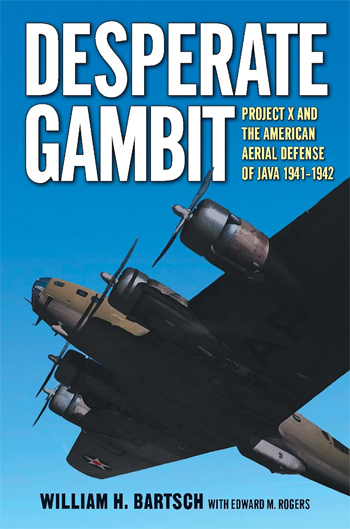
Coming soon from Texas A&M University Press and authors William H. Bartsch and Edward M. Rogers is Desperate Gambit: Project X and the American Aerial Defense of Java, 1941–1942, which reveals the untold story of how the Army Air Forces sent some eighty B-17 Flying Fortresses nearly 7,000 miles to Java to oppose the Japanese invasion.
In the dark days of World War II, just after Pearl Harbor, Japanese forces were moving almost at will across Southeast Asia and the Pacific. With his troops besieged in the Philippines and his bomber and fighter squadrons decimated, General MacArthur pressured the US War Department to provide urgent help, particularly for replacements for the B-17 bombers devastated in the December 8 attack on Clark Field. President Roosevelt committed to send a large force of heavy bombers and their crews to the Philippines, a reinforcement plan code named “Project X.”
During the following weeks, the Air Force Combat Command made frenzied efforts to access the sixty-five Boeing B-17Es and fifteen Consolidated LB-30 heavy bombers that comprised the Project X force. The novice crews that were cobbled together would be required to fly their bombers two-thirds of the way around the globe, from MacDill Field in Florida to their new destination on the island of Java, where they were immediately thrown into combat. Project X, as the first test of the doctrine of strategic bombing, was an assignment unprecedented in US military history, though it was ultimately doomed to fail.
Continuing his masterful series of books on the air war in the Pacific Theater, military historian William H. Bartsch with Edward M. Rogers take readers inside the headquarters planning rooms, the front-line command posts, and the cockpits of the aircraft to chronicle another chapter in the early days of the Allied effort to meet the Japanese challenge. Desperate Gambit: Project X and the American Aerial Defense of Java, 1941–1942 will be eagerly received by both general readers and professional historians interested in In the dark days of World War II, just after Pearl Harbor, Japanese forces were moving almost at will across Southeast Asia and the Pacific.
The 584 page narrative draws on participant diaries, mission reports, a newly discovered AAF planning file, and Allied and Japanese sources. Includes 32 black-and-white photos, line art, six maps, an appendix, bibliography, and an index. It is currently available for pre-order with release set for October 12.
Please Note: This post contains an Amazon affiliate link. When you purchase through links on our site, we may earn an affiliate commission.